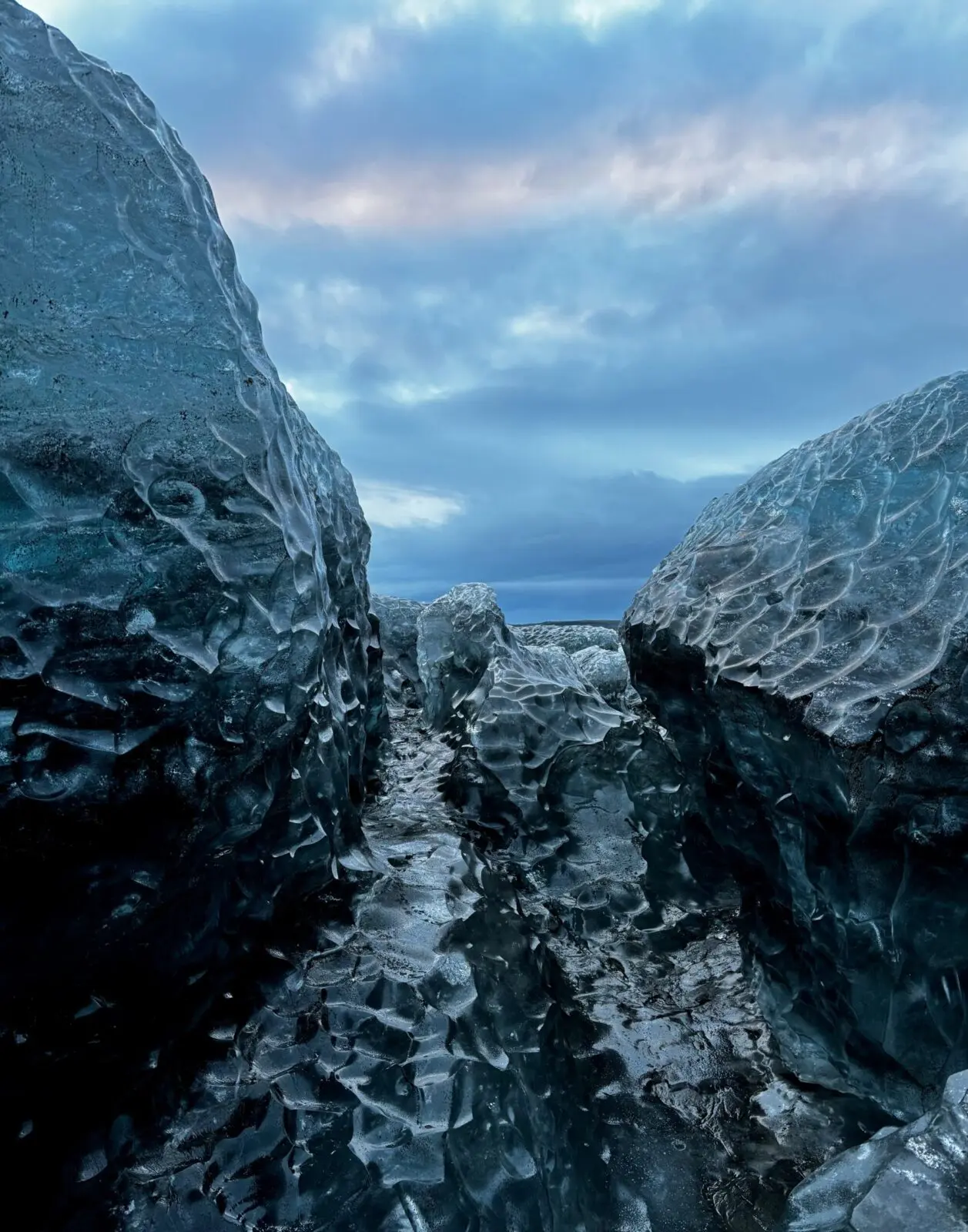
Can I still walk on an Icelandic glacier in my fifties?
I nearly talked myself out of the glacier hike. It wasn’t the cost or the weather that gave me pause. It was the image in my head of scrambling over ice, trying not to fall, wondering why I’d thought this was a good idea. Surrounded by twenty-something backpackers, obviously.
There’s something about the word glacier that makes it sound more extreme than it probably is. And at 55+, you do start to question whether certain activities are still a good fit. That familiar little voice asking “will I fit, will I cope?” has become part of travel for me in a way it never was twenty years ago.
I needed to know: was hiking a glacier at 55+ a good idea or should it remain forever on the bucket list?
Here’s the quick answer. Read on for the long answer with all the details.
Quick answer: yes, you can do a glacier hike at 55+
We did, and we are very glad we did. Age was not the thing that mattered most. What mattered more was feeling fairly steady on our feet, being able to manage uneven ground, and being willing to be a little cold, a little challenged, and a little outside our comfort zone.
Suitable for you if…
you walk regularly, have decent balance, and like the idea of an active adventure rather than an easy sightseeing stop.
Maybe skip it if…
you feel very unsure on slippery ground, struggle with longer walks, or want something easy and effortless.
Before you book
- This is a guided activity, so you are not out there on your own.
- You are given the safety gear you need, usually including crampons and a helmet.
- The challenge is more about balance and footing than speed.
- Weather and glacier conditions can change plans, sometimes at short notice.
- You will want warm waterproof layers, gloves, and sturdy walking boots.
- If your tour includes an ice cave, access depends on conditions and time of year.
Bottom line: if you are reasonably active, fairly steady on uneven ground, and open to a bit of adventure, a glacier hike at 55+ can be completely realistic.
What I had not really been able to picture beforehand was what it would actually feel like. On paper, it all sounded quite manageable. But that is a different thing entirely from standing on the ice with crampons on, knowing there is no longer anything theoretical about it.
So here’s what it was really like. Spoiler: I’m glad I didn’t talk myself out of it.
Arrival at Vatnajökull and meeting the glacier guide
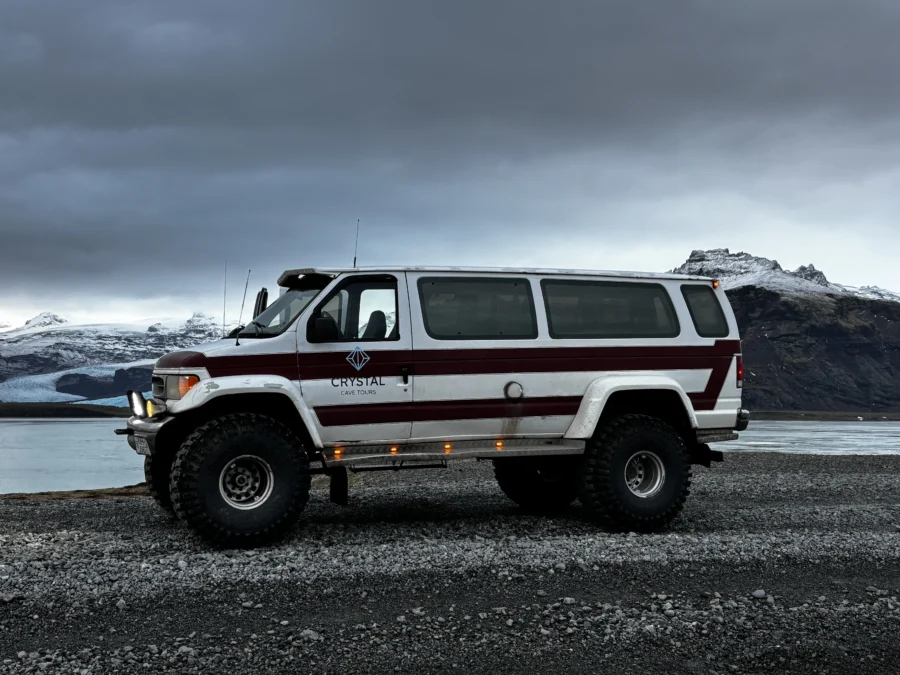
It was still completely dark when we climbed into our minivan with the rest of our tour group and Vlad from Transylvania, our guide. (Yes, he made the Dracula joke himself before we could.) Vlad had kept us safe and warm over the previous few days, making sure we didn’t wander off, disappear into the sea, or encounter any other misfortune. This glacier business, however, was beyond him. He drove us to the parking lot near Vatnajökull and handed the reins to Fannar, our glacier guide. Fannar issued crampons and helmets, then herded us into the “superjeep”. Not really a jeep, more like a Monster Truck with better suspension and zero concern for comfort.
For anyone driving themselves: the approach is similar. Just take your rental to the Jökulsárlón parking lot, watch out for Icelandic gravel, sheep, and sudden gusts of wind. You still can’t go onto the glacier without a guide, so from there, the experience is essentially the same.
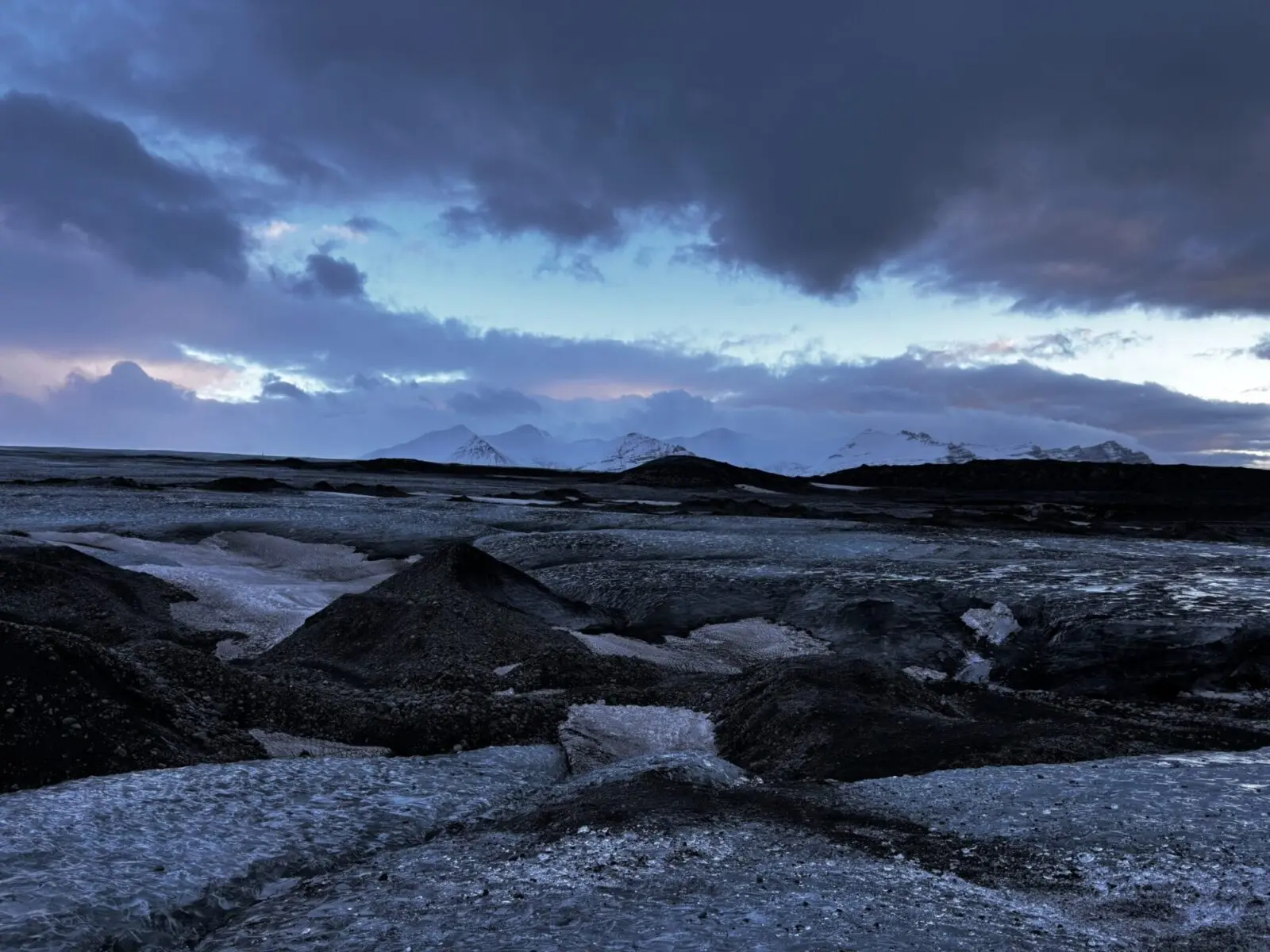
Superjeep ride to the glacier
I have to say, it was a tight squeeze to get all of us into the truck. So tight, in fact, that with four of us crammed into the last row, there was barely enough room to even fasten the seatbelts. On the bright side, we were wedged together so firmly that seatbelts felt largely theoretical.
The ride itself, still in the dark, was bumpy, steep, and enthusiastic. Fannar, like all his fellow guides, was a pro at delivering information while driving difficult terrain, preferably one-handed. After about twenty minutes of speeding (very bumpily) over the glacial moraines, we arrived at the edge of the glacier.
We fastened crampons under our shoes (some more efficiently than others), donned our helmets, and gathered around Fannar. He showed us how to walk on the ice: feet straight down, with some force, so the crampon spikes actually bite. Step too gently and the crampons won’t grip, at which point you might as well be wearing flip-flops.
We did not get ice axes. Disappointing for some, but Fannar explained there had been incidents involving people swinging them a bit too enthusiastically. I’ll leave the outcome to your imagination. Outfitted and feeling like polar explorers, we finally stepped onto the glacier.
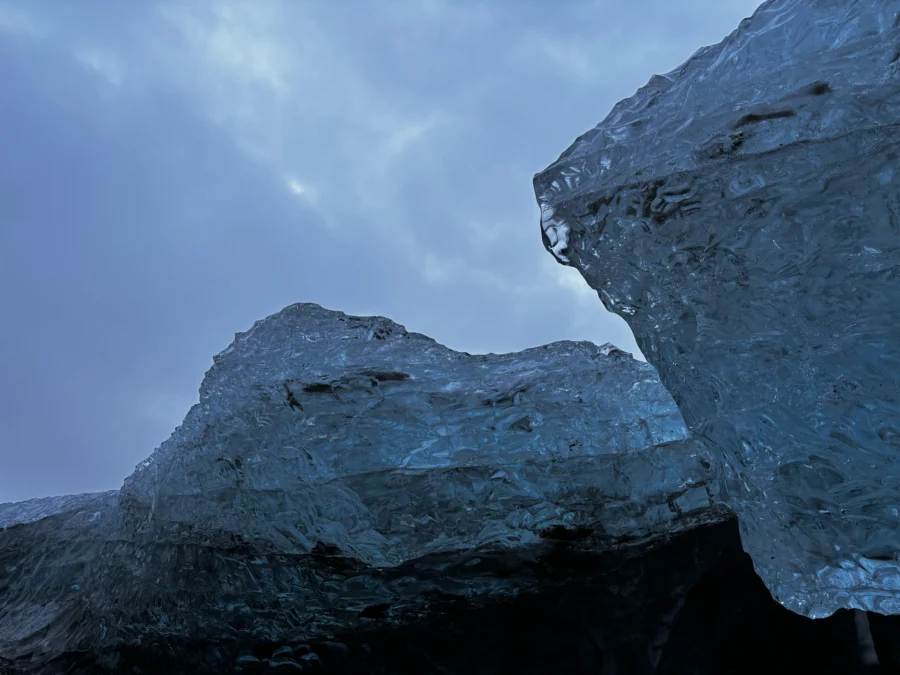
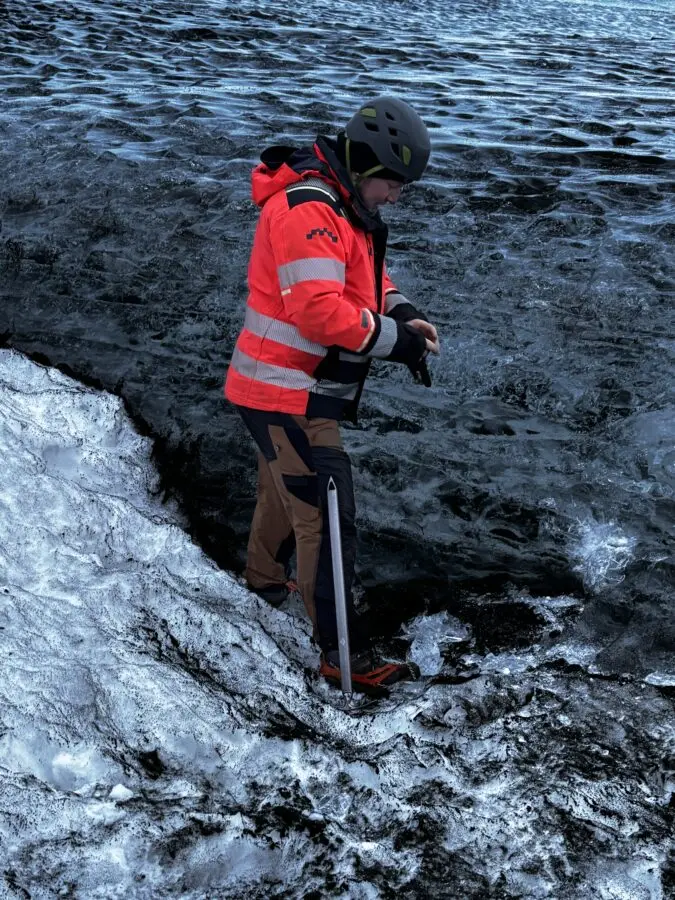
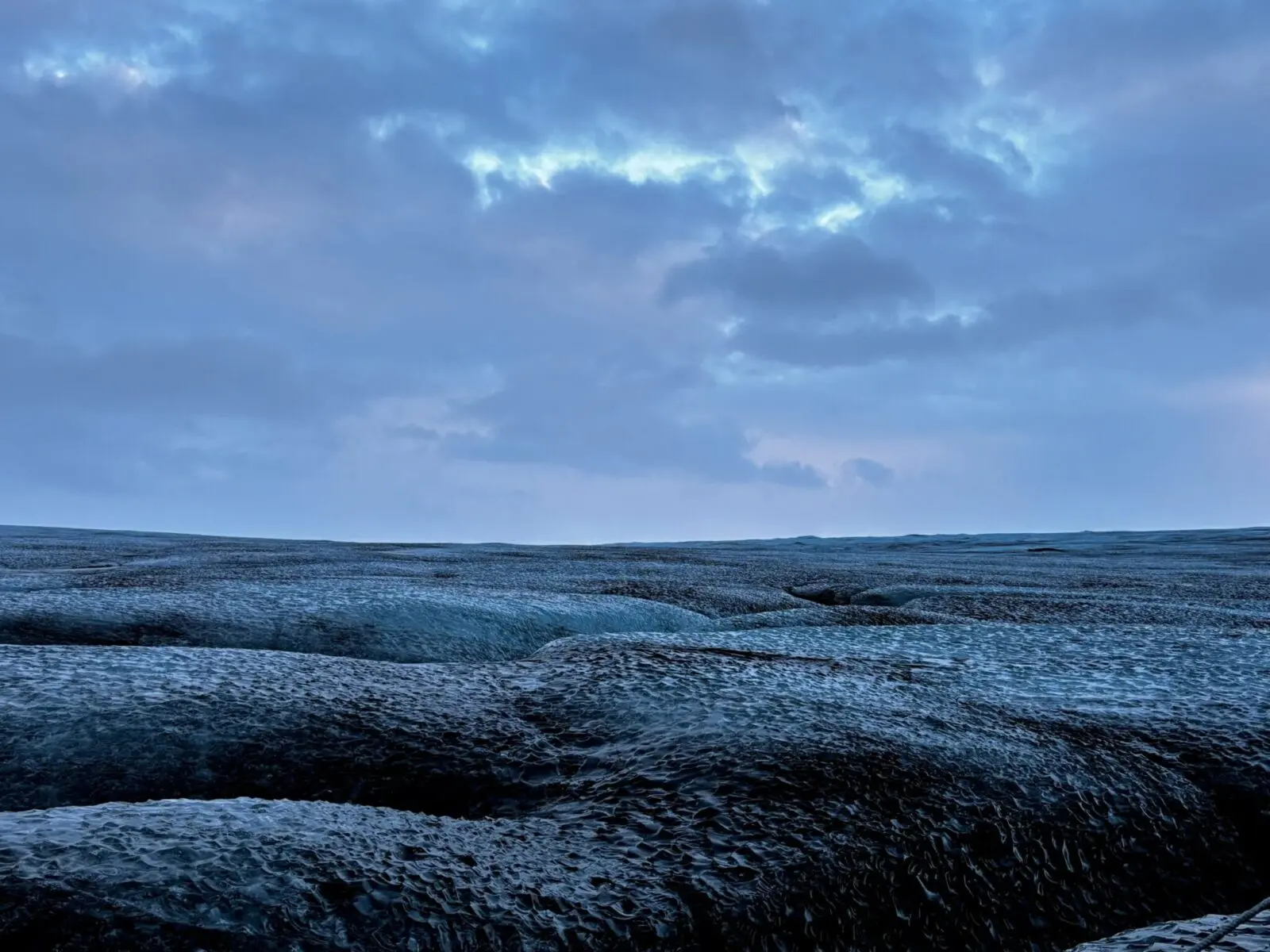
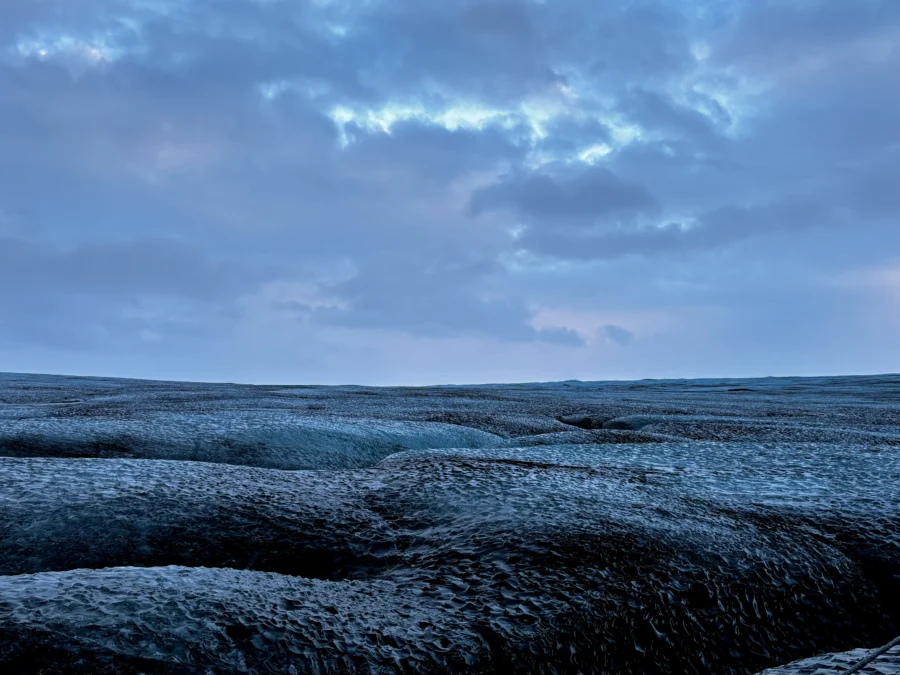
First steps on the ice
My first steps on the ice were a bit tentative. Would the crampons work? Would I get the hang of walking in them, or would I slip and tumble headfirst into a crevasse? I noticed the same cautious approach from others around me.
It quickly became clear, though, that putting your feet straight down with some force really did the trick. Walking on the ice felt steady and surprisingly easy. Even going uphill or downhill, I never felt like I was about to lose my balance or start a slightly too-fast descent. Within minutes, all of us were walking as if we’d been doing this for years. A younger member of our group even decided to try some ice climbing, but was quickly talked down by Fannar.
As we went along, Fannar pointed out ice formations and explained how glaciers form, how slowly they grow, and how alarmingly fast they’re melting. He told us why glacier ice is transparent or even blue, instead of opaque and cloudy like the ice cubes in your drink. Ice cubes, apparently, are frozen water, while glaciers are made of snow compressed over hundreds of years until there’s no oxygen left in it. Apparently, you can’t see through water. I’ll admit he lost me there.
Not that I minded: I was too busy marvelling at my surroundings and taking a lot (A LOT) of photographs: the colours and patterns in the ice, the sheer size of the glacier, the mountains in the distance. Fannar offered to take photos of everyone in the group. I was happy to get a few of Marc and me together, but overall I preferred the shots without me blocking the view. Judging by the number of selfie sticks, I was in the minority.
After about an hour on the ice (which felt like minutes) we arrived at the highlight of the expedition: the blue ice cave.
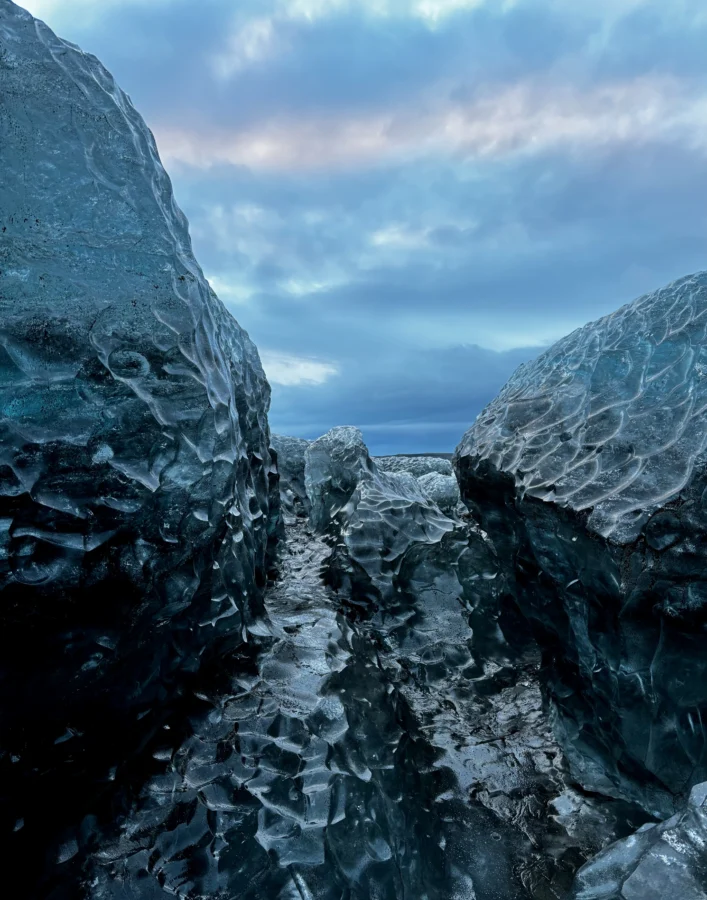
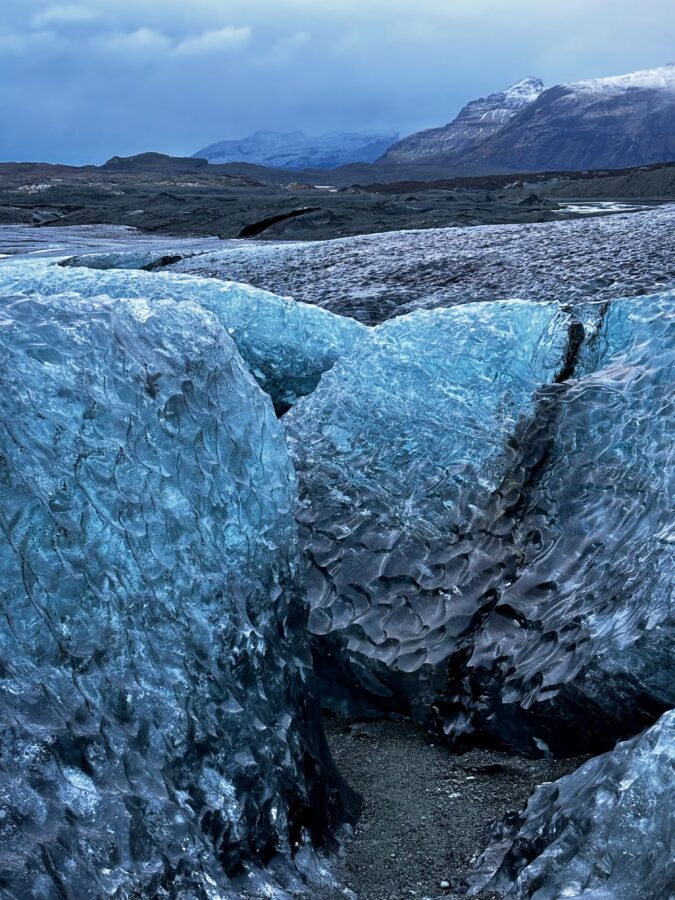
Ice cave exploration
We had to wait a few minutes for another group to leave the ice cave, which gave Fannar ample opportunity to tell us more about ice caves. What struck me most was that the very cave we were about to enter might be gone within days. As I write this, just weeks after our visit, it quite possibly no longer exists. A fascinating, yet rather melancholic thought.
Ice caves are constantly forming and melting, and each autumn a team of glacier guides sets out to find new ones that are safe to visit. Sometimes they can return to the same cave all winter; sometimes they have to find a new one by February. Apart from the Katla cave, ice caves aren’t accessible in late spring or summer: once the ice really starts to melt, they can flood or collapse. Not ideal if you happen to be inside.
If you’re curious why the Katla ice cave is accessible in summer, you can read more about that here. But I digress.
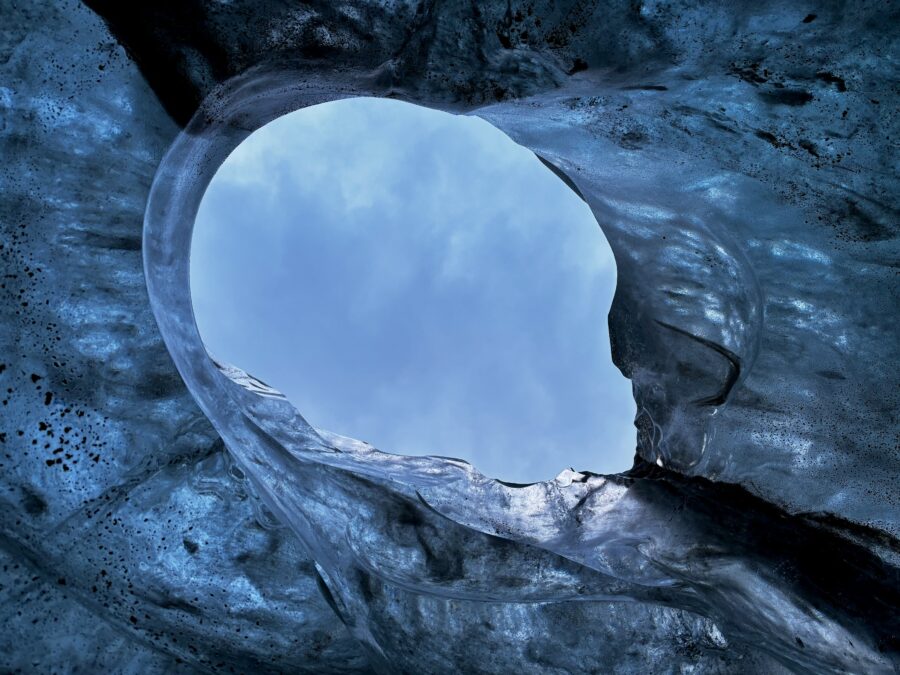
After a short wait, we were finally able to enter the cave. What can I say? I can’t really describe it beyond this: it was magical, otherworldly, and quite possibly one of the most beautiful things I’ve ever seen. I’ll let the photos speak for themselves. No photoshop, no filters, and the photos don’t even do reality justice.
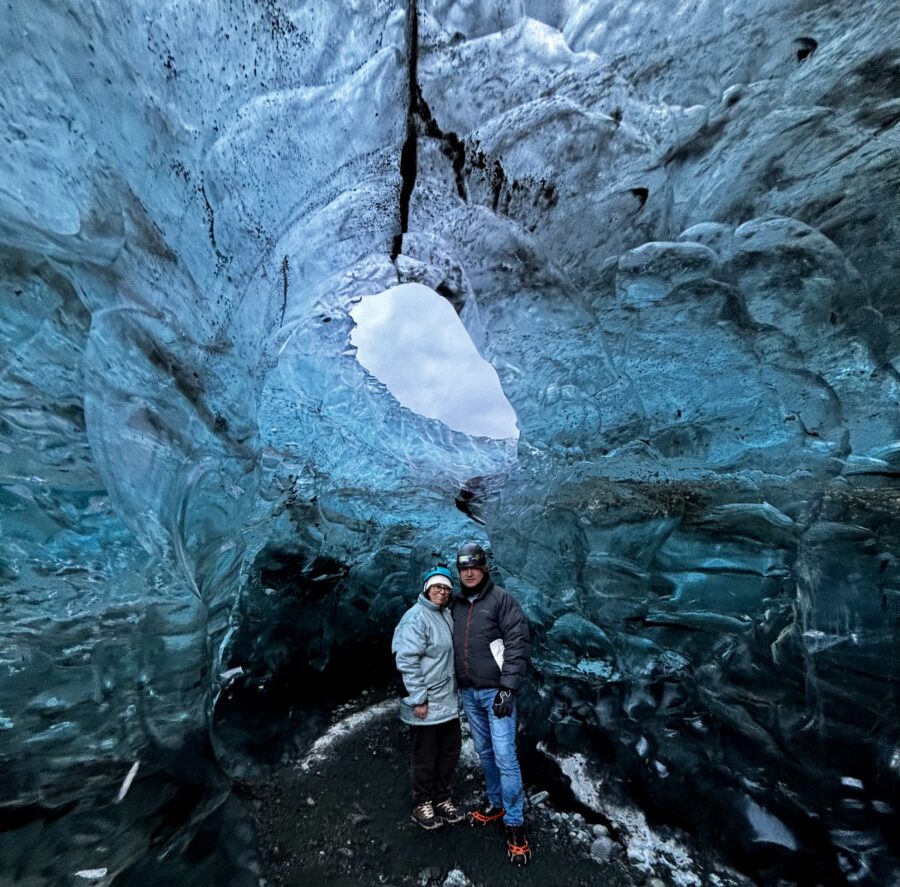
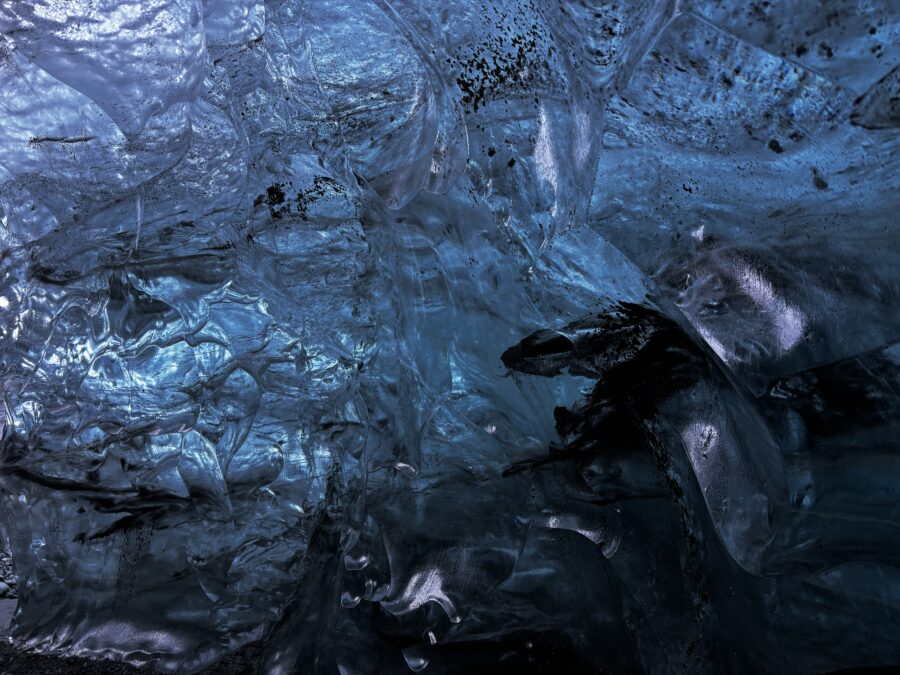
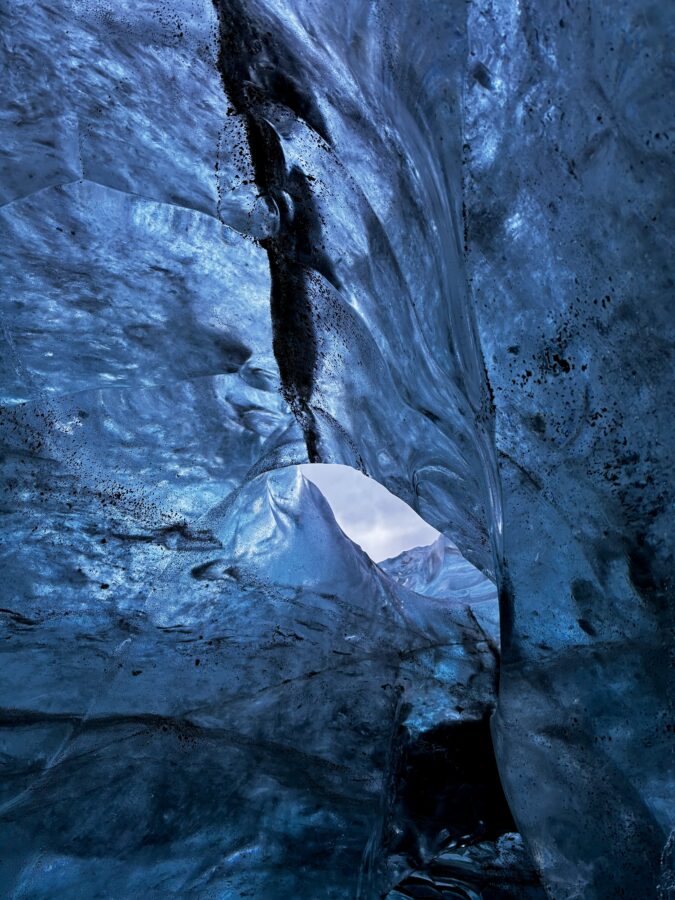
Views from the glacier, Jökulsarlón and Diamond Beach
After wandering around the cave in bewildered awe for a while, it was time for us to head back to the Monster Truck. It was fully light by then, which gave us a chance to see the spectacular views that had been hidden from us on the way in. We stopped for photos for a few minutes, before the next wild ride across the glacier. I’m pretty sure Fannar added a few extra hills and climbs to make the ride a bit more spectacular. I appreciated his efforts and the adventurous drive, especially because this time I had skillfully maneuvered myself into the front seat.
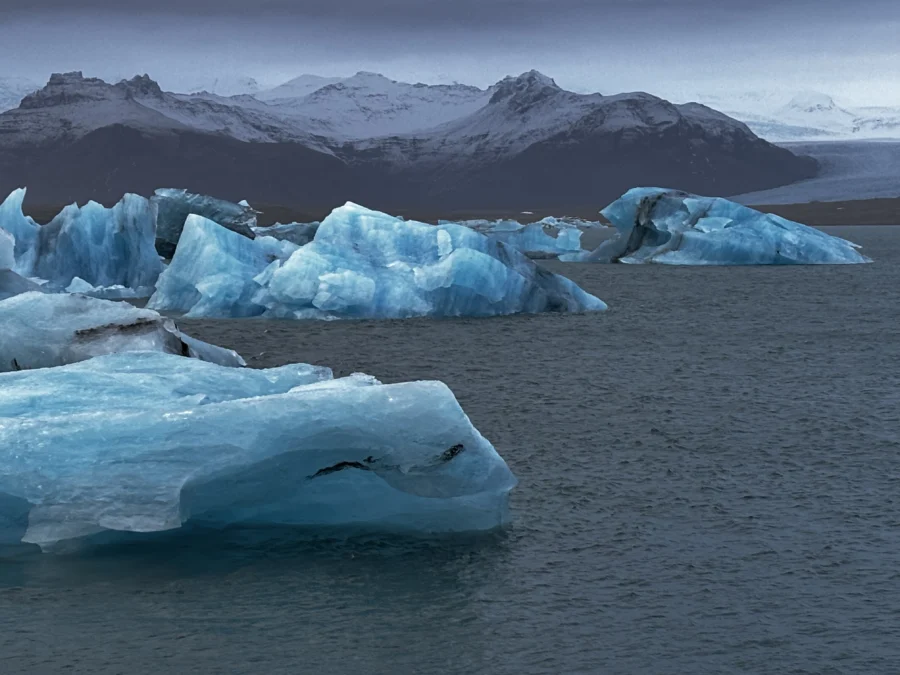
Straight from the glacier, we were treated to more ice; this time floating through the lagoon in spectacular shades of blue. Icebergs break off from the glacier and drift around here for a while. Once they’re small enough to slip under the bridge carrying the Ring Road across the lagoon, they float out to sea. Seals swim in the area too, and we were lucky enough to spot a few. After we’d had our fill of the view (and were in dire need of warming up in the minivan), we drove a few hundred meters to Diamond Beach. We could easily have walked, but between the cold temperatures and the ever-present wind, I decided I didn’t need to prove a point.
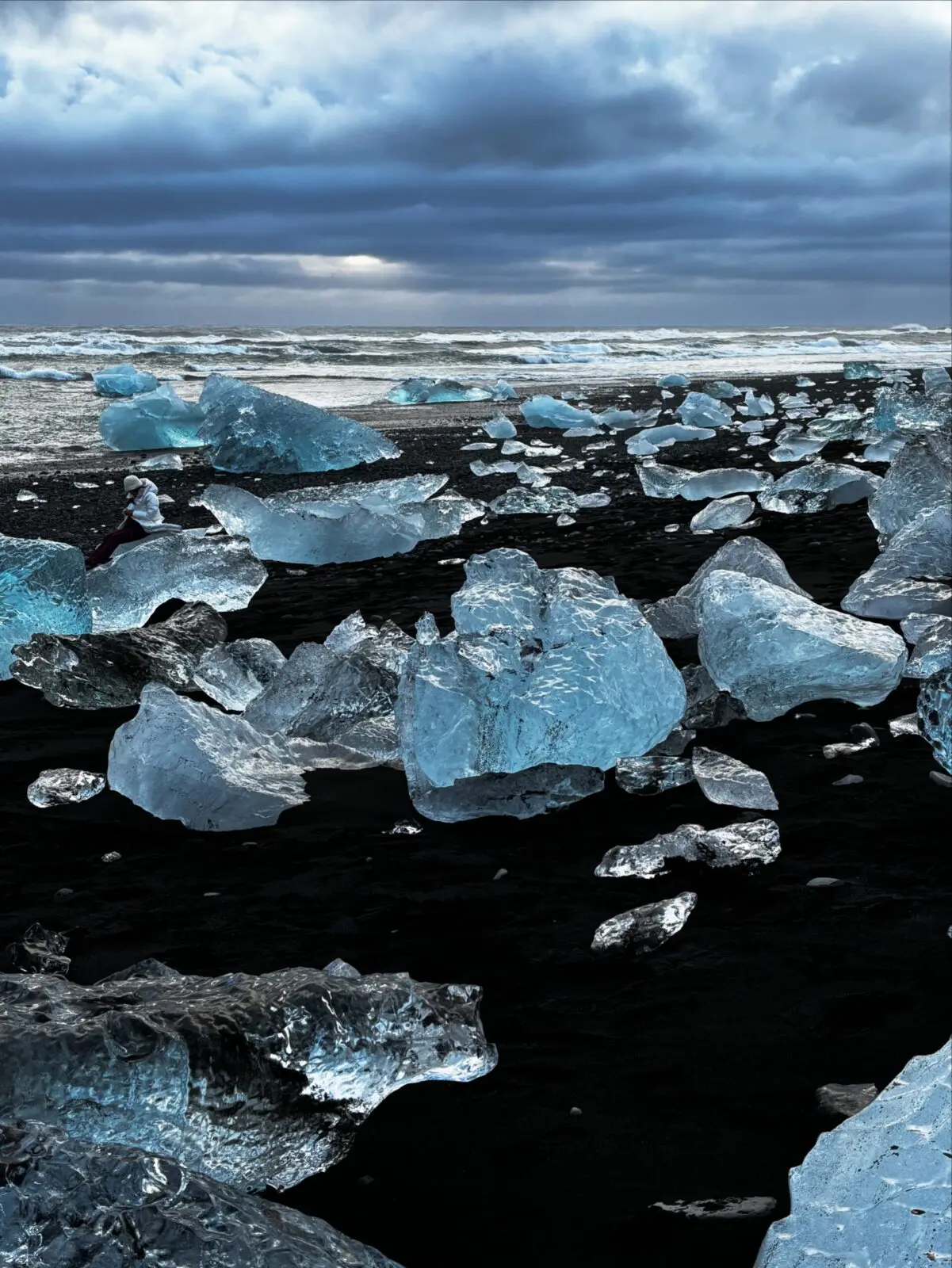
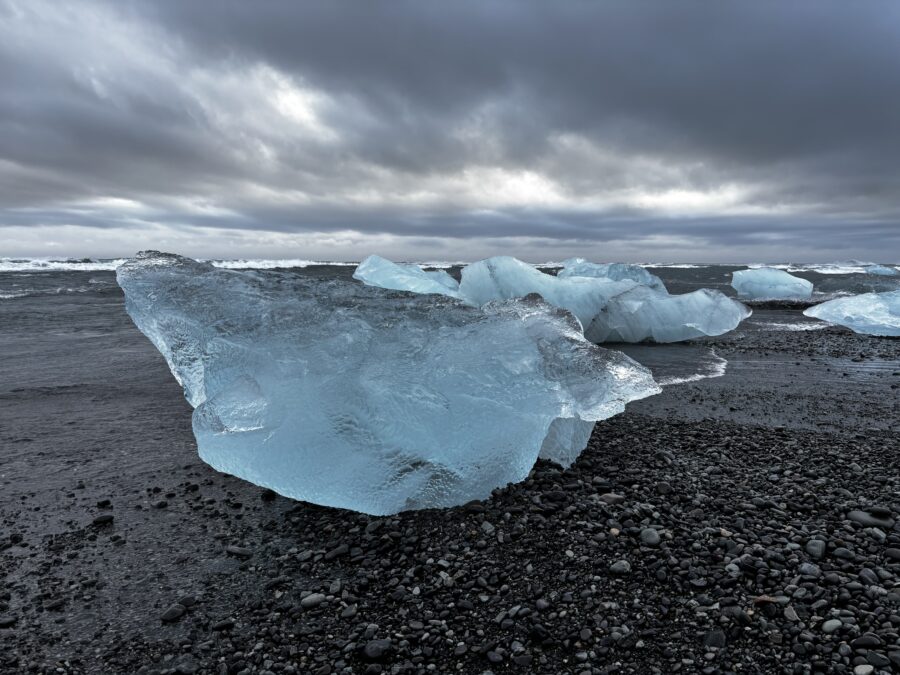
We filed out of the minivan near Diamond Beach and stepped onto the sand. Tides, currents, and weather decide whether glacier ice makes it onto the beach, so some days it sparkles with chunks of ice, and other days it’s almost empty. We were lucky. Actually, we were doubly lucky. There was no snow, so the sand was deep black, and ice was scattered everywhere. Some pieces were tiny, glittering like diamonds. Others were massive, the kind that could sink the Titanic. It was breathtaking, and I spent a long time happily walking among the ice and snapping photos. Just be careful not to get too close to the water. The current is incredibly strong, and the ocean is freezing. There aren’t sneaker waves like at Reynisfjara, but it’s still wise to keep an eye on the tide.
By the time we climbed back into the minivan, the sun was dipping low, and I felt a mix of awe and quiet satisfaction. Glacier hikes, floating ice, black-sand beaches: experiences like this remind you that adventure doesn’t have an age limit. If you’re 55+ and wondering what it’s really like to take on Iceland’s icy landscapes: below are the questions we hear most often.
Answers to questions we asked ourselves before going.
Honestly, you don’t have to be an athlete. On our ice cave and light glacier tour, we walked on uneven, icy surfaces for a few hours, sometimes uphill. At the really steep sections, steps had been carved into the ice. If you can manage a few kilometers on uneven terrain and handle some stairs, you’re good. If you want to read more about general fitness requirements in Iceland: read this.
Glaciers are naturally a bit intimidating: slippery ice, fast-changing weather, and strong currents near icebergs. But guided tours make it very manageable. Stick with your guide, wear your crampons, and pay attention to safety tips. Even at 55+, it’s totally doable if you respect the ice.
Guided tours provide crampons, helmets, and sometimes harnesses. Beyond that, layer up, bring waterproof clothing, gloves, a warm hat, and good boots. You’ll thank yourself when the wind picks up or the rain starts coming from all directions. Not sure what to pack? Have a look at my packing post.
The weather in Iceland is predictably unpredictable. Be ready for wind, rain, sun, or all three in one day. Dressing in layers and having waterproof gear is key. And always listen to your guide: they know when to pause, turn back, or keep going.
When doing an ice cave tour, you will do shorter walks, usually on flatter parts of the glacier. You get crampons and helmets, and the main focus is exploring the stunning ice formations rather than trekking long distances. We did one like this and loved it.
Full glacier hikes are longer, steeper, and more physically demanding. You might be navigating open glacier surfaces and crevasses with ropes. Definitely more stamina required.
Ice cave tours are often 2–4 hours including transport. On our tour, we spent about two hours on the ice, an hour bumping over the glacier, and another hour staring out at the spectacular views.
Longer glacier hikes can take half or full days. We didn’t do this so I cannot tell you how hard they are. When in doubt, contact one of the many companies offering these tours.
Technically? Yes.
Realistically? Not a great life choice.
Icelandic glaciers are full of hidden crevasses, slippery ice, and “that looks solid” moments that definitely aren’t. Unless you’ve got proper gear and glacier experience, going without a guide is asking for trouble. Guides bring the gear and the know-how and greatly improve your odds of making it back for dinner.
Not realistically. It’s a five-hour drive from Reykjavík to the glacier, in good weather conditions. Much more in inclement weather. Don’t do it to yourself: book a hotel if you’re self-driving or join a multi-day tour.
This hike was part of our short Iceland trip (you can find our complete Iceland guide here)