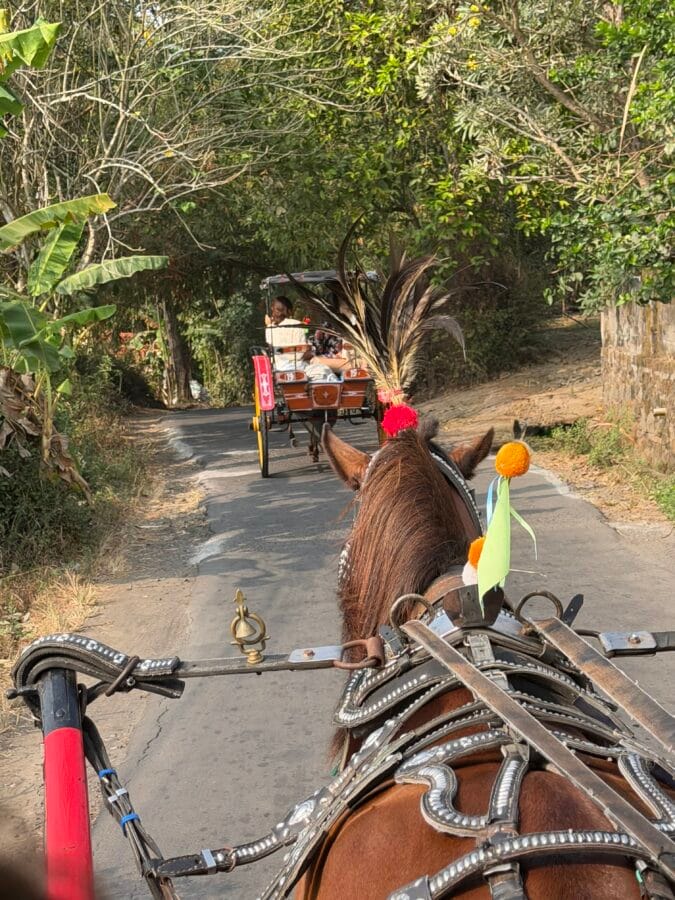
I was supposed to cycle to Borobudur. Instead, I got to stare at the back end of a horse.
I was supposed to cycle through the countryside to Borobudur. Unfortunately, I was still recovering from strep throat, and a blood pressure that had plummeted somewhere in Sumatra. Cycling was very much not happening. Marc, on the other hand, was perfectly happy. He loves cycling and needs remarkably little encouragement to get on a bicycle.
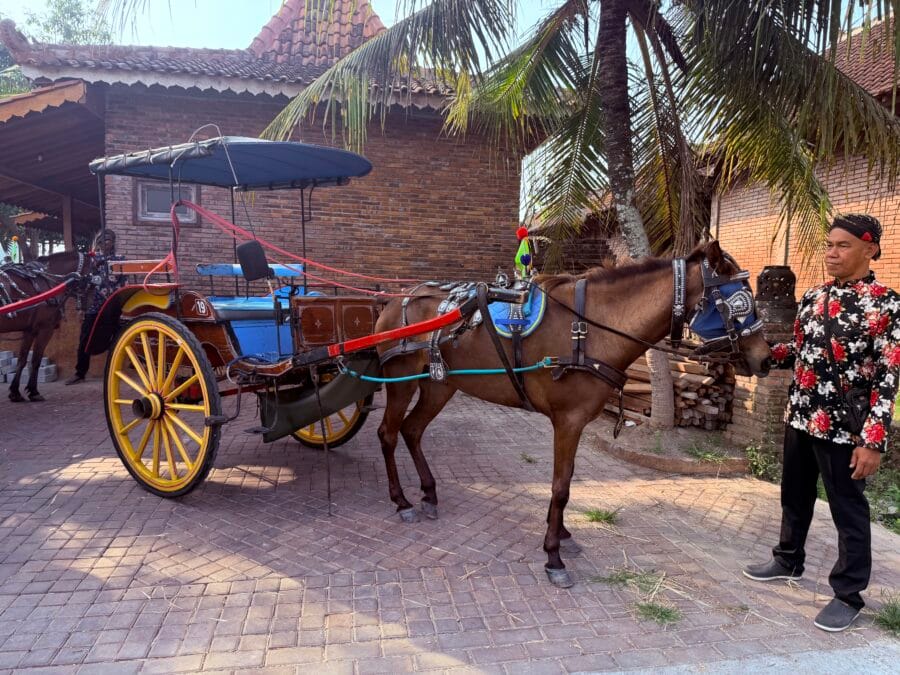
The travel agency arranged a horse and carriage for me instead, which I paid extra for. Another Dutch family was on the same tour, and the plan was for their children to ride in a second carriage while the parents cycled. Then the parents decided they didn’t want to cycle either. There were five people and two carriages. Some of us had paid extra because we genuinely couldn’t cycle. Some of us had simply decided cycling looked like hard work.
So while Marc cycled through the Javanese countryside towards Borobudur, I found myself squeezed into a tiny carriage with two complete strangers, watching the back end of a horse.
This was not the only thing that wouldn’t go entirely according to plan on an otherwise very enjoyable day.
07:30: the hotel pick-up
When going on a tour in Indonesia, expect an early alarm. Every single tour we’ve been on started somewhere between 7 and 8 a.m. This is, of course, because nobody wants to be out and about when it’s hottest. But if you expect lazy mornings and leisurely breakfasts, skip the tours. Our tour to Borobudur had a pick-up time of 07:30, which gave us just enough time to have breakfast and go outside to wait for our ride. Our driver arrived exactly on time and we got into the obligatory minivan with, of course, a Dutch family.
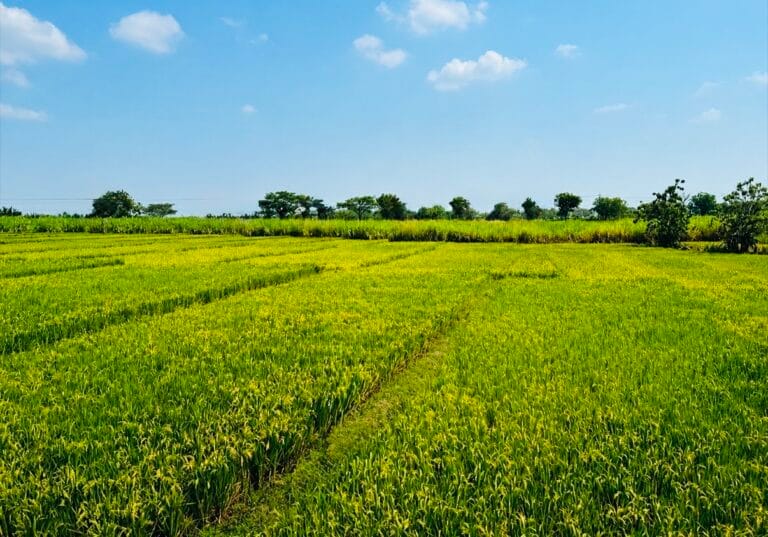
If you imagine a cycling tour from Yogyakarta to Borobudur starting in the middle of the city, you’d be wrong. And this is a good thing. Yogyakarta traffic is busy, noisy and chaotic. Even by car it takes forever to get out of the city and into the proper countryside. It took us about an hour of cars honking, people standing in the middle of the road waving cars through, and about a million motorcycles to get out of the city and into a quieter place. When we saw Borobudur looming in the distance, we took a turn onto a small road and came to a halt at our first stop: a small resort in the middle of the rice fields. Our horse-and-carriage combinations were already waiting for us, as was our guide, who turned out to be from Belgium.
We got a cup of tea, Marc got to choose a bike and do a little demonstration to show the guide he could actually cycle. This amused us to no end, as Marc cycles 100 km tours for fun. The Dutch parents tried on helmets and bikes too. They never made it to the demonstration part, because this was where they decided they would also quite like to stare at the back end of a horse instead.
The guide asked me if I had an issue with that. I was, of course, not going to admit that I did, indeed, have an issue with that. Let’s keep things civil. They seemed nice enough.
The first stop: tofu, a collapsed roof and strange-looking goats
Marc and not one but two guides mounted their bikes, we climbed into the carriages, and the horse drivers joined us and set the whole procession in motion. It must have been quite the sight: a guide, one lonely cyclist, two horse-drawn carriages and another guide bringing up the rear. We did get some stares before arriving at our first stop: a little tofu… was it a factory? A shed, more like.
Two men were waiting for us and instantly started apologising because they couldn’t show us how they made their products. There had been a storm the night before and the roof had collapsed. But would we like to see the goats instead?
We went outside and saw a number of very strange-looking goats. They had long ears, long faces and a very distinct smell. The two little Dutch girls travelling with us absolutely loved them, which was wonderful. I enjoyed myself too, because there was a cat and I didn’t have to try tofu.
The second stop: a pottery class and some lovely snacks
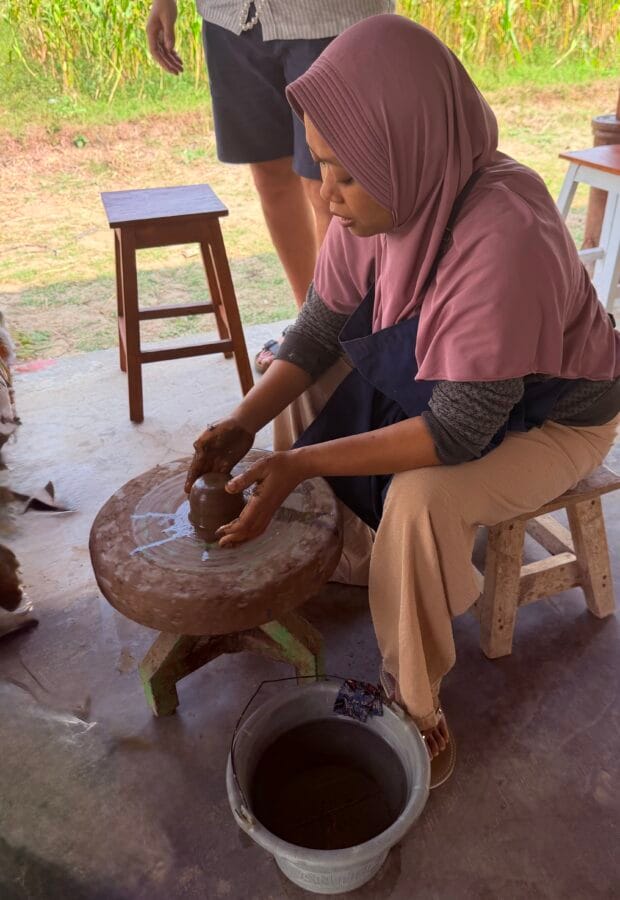
After saying goodbye to the goats, the cat and the men trying to fix the roof, we went back to our transport and rode through the beautiful countryside to our next stop: a pottery. Local women were creating lovely pots, plates and bowls. On top of that, they gave pottery classes. Now, the last time I tried to make anything out of clay, I was seven and had to make an ashtray for my non-smoking dad. It was, after all, the seventies.
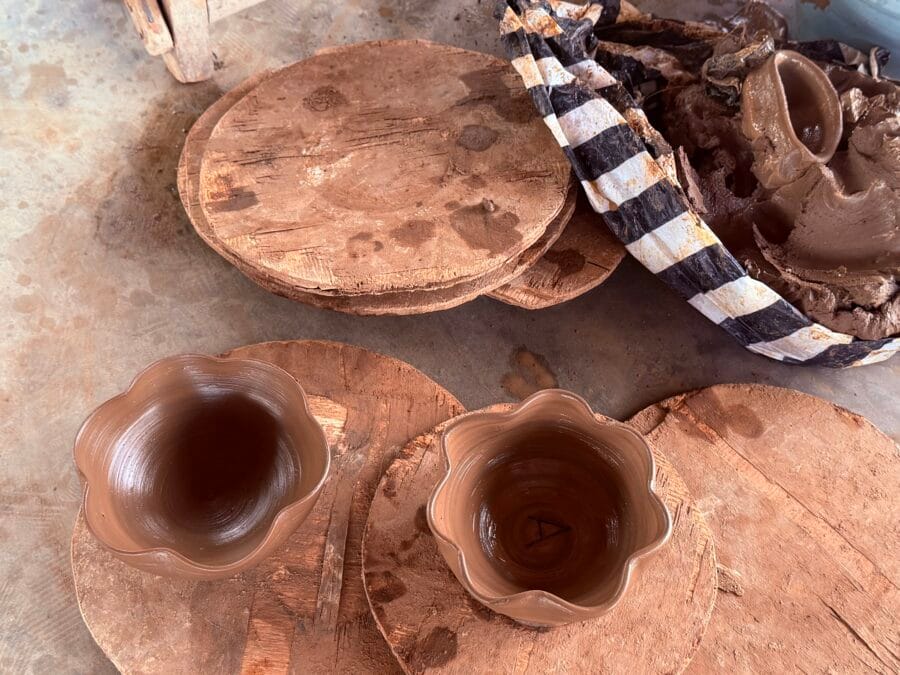
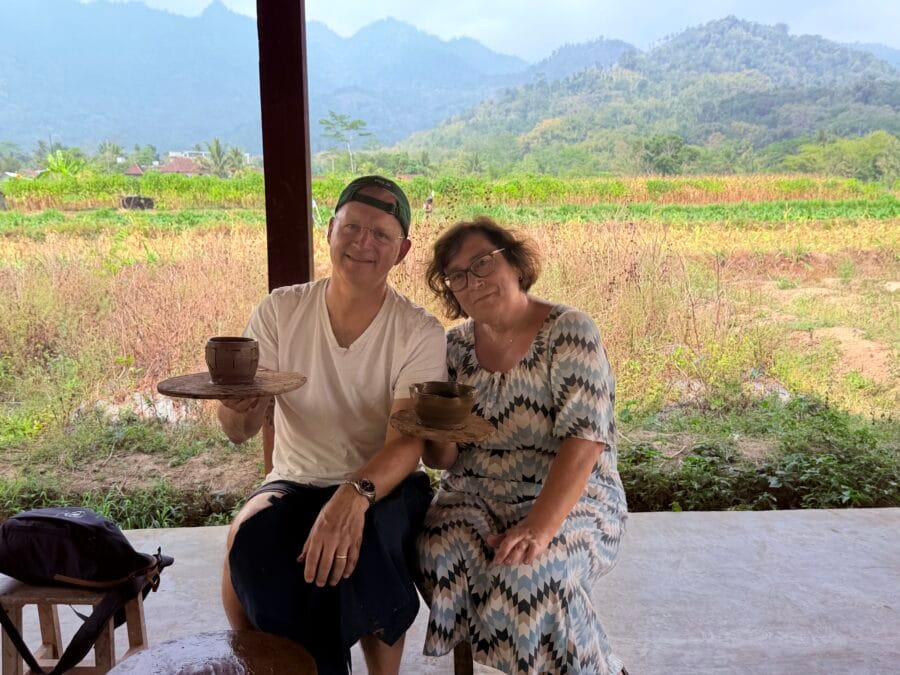
This time went much better. We were sat down on little stools, given a lump of clay and told to turn it into a bowl. The teacher was spinning the pottery wheel and making sure my lump of clay didn’t collapse in on itself and turn into an ugly-looking plate instead. She did this so well that it felt like I was doing it all by myself. I declared myself a natural, set my bowl out to dry and gave Marc his turn on the pottery wheel. He managed to wreck his bowl three times, despite the teacher’s best efforts, because his hands were too strong. The teacher found this hilarious.
After our creative efforts, we got to sit down with a cup of tea and some snacks: fried banana, cassava crackers and fried tempe. We decided not to buy our beautiful little bowls. They’d be delivered to our hotel after they’d dried, but I wasn’t going to keep them alive through another ten days of Indonesia. The Dutch family did buy their work and had it shipped to the Netherlands. I liked my bowl, but not that much.
After this executive decision, it was time for more staring at the back end of the horse.
Stop three: coconut sugar, more tea and women in VW beach buggies
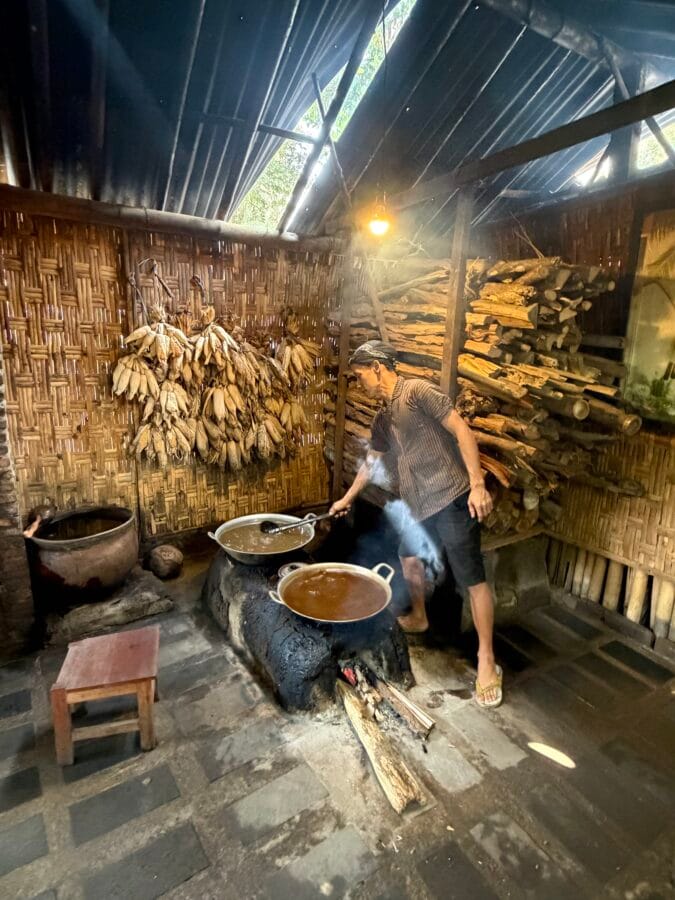
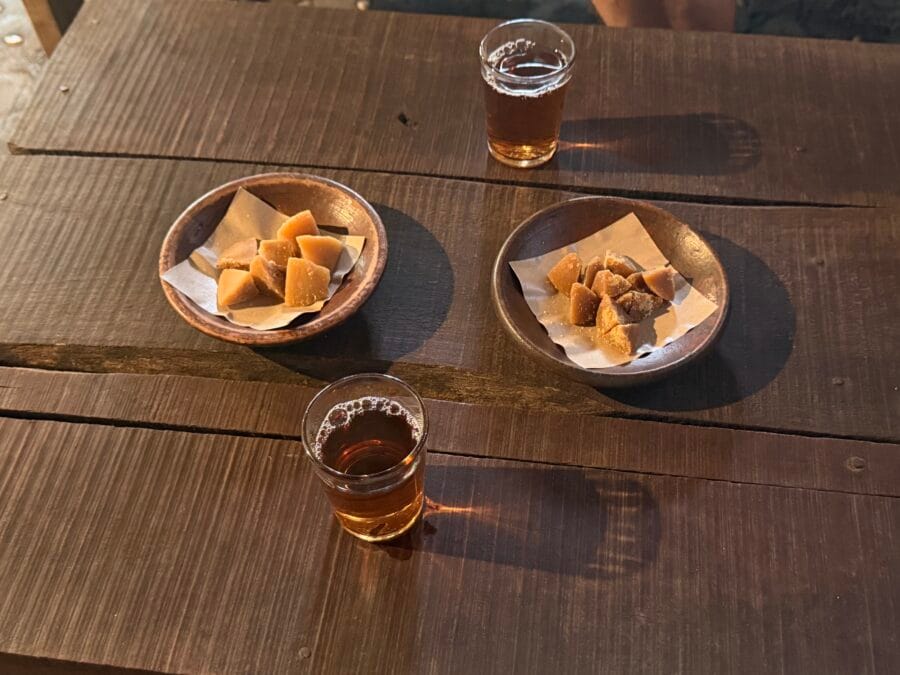
There isn’t a huge amount to report from this stop. We got a demonstration how coconut sugar is made, we got more cups of tea and we got two types of coconut sugar to try: regular and ginger. It was nice, and it was all served in a lovely little place.
The most memorable part was probably the group of about 20 Indonesian women who had arrived in a fleet of little VW beach buggies. They were having a much more exciting time than we were.
And that’s about it. Sometimes a tour stop is just a lot of tea, some coconut sugar and 20 women in beach buggies. Time for more staring at the back end of the horse.
Unexpected levels of organisation at the entrance to Borobudur
Around 11:30 a.m. we arrived at Borobudur. We parked our horses and bikes and walked up to the main entrance of the park. This is where we found out two things: we were actually going to climb the monument itself, and Indonesia can do organisation if it wants to.
The first is no longer a given. Before 2020, pretty much everyone could climb the temple, with reports of up to 50,000 people a day. The park opened early so people could watch the sunrise from the temple, but this overtourism led to damage to the monument. After the Covid-19 pandemic, authorities made some major changes. Only 1,200 people a day can now climb the monument itself, although cheaper tickets to enter the park and see it from up close are available. Access is only allowed when accompanied by a guide and is restricted to one hour. Every visitor climbing the temple also has to wear special bamboo slippers to prevent further damage. Local communities are involved in making these slippers. Because we weren’t sure we would actually get to climb the temple, this was a pleasant surprise.
Another pleasant surprise: it had a level of organisation that felt almost… Dutch?
Upon entering, we had to leave larger bags and all food and drink at the bag storage area. We received a bracelet with a QR code, which took us through the automatic toll gates. From there, we walked over to the little electric trains that took us to the main visitor area. Here we showed our bracelets, received a bag with our slippers and a bottle of water, and we got the number of our tour. After that, all we had to do was wait for our number to be called.
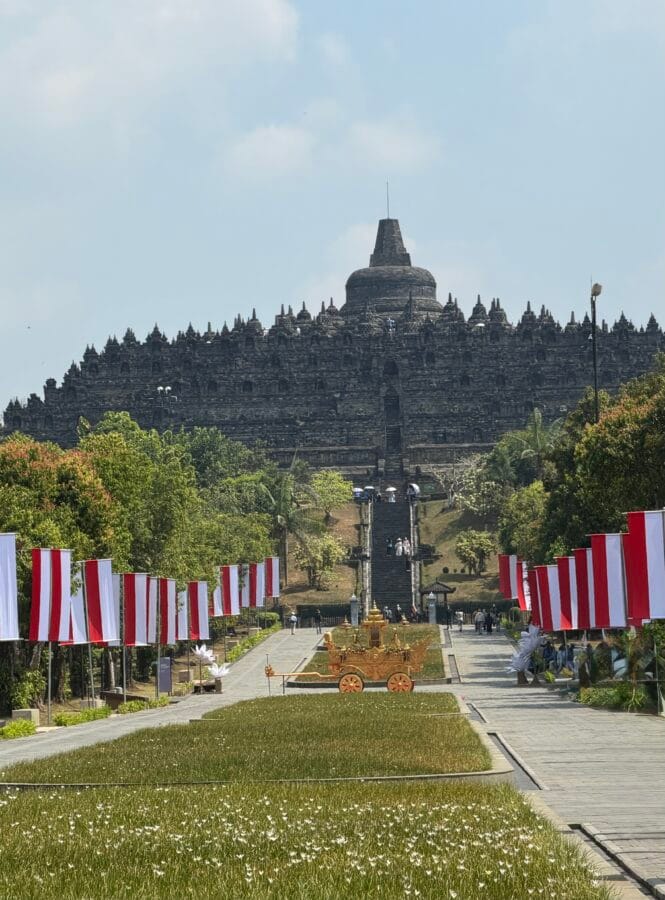
A 1,200-year-old stone puzzle
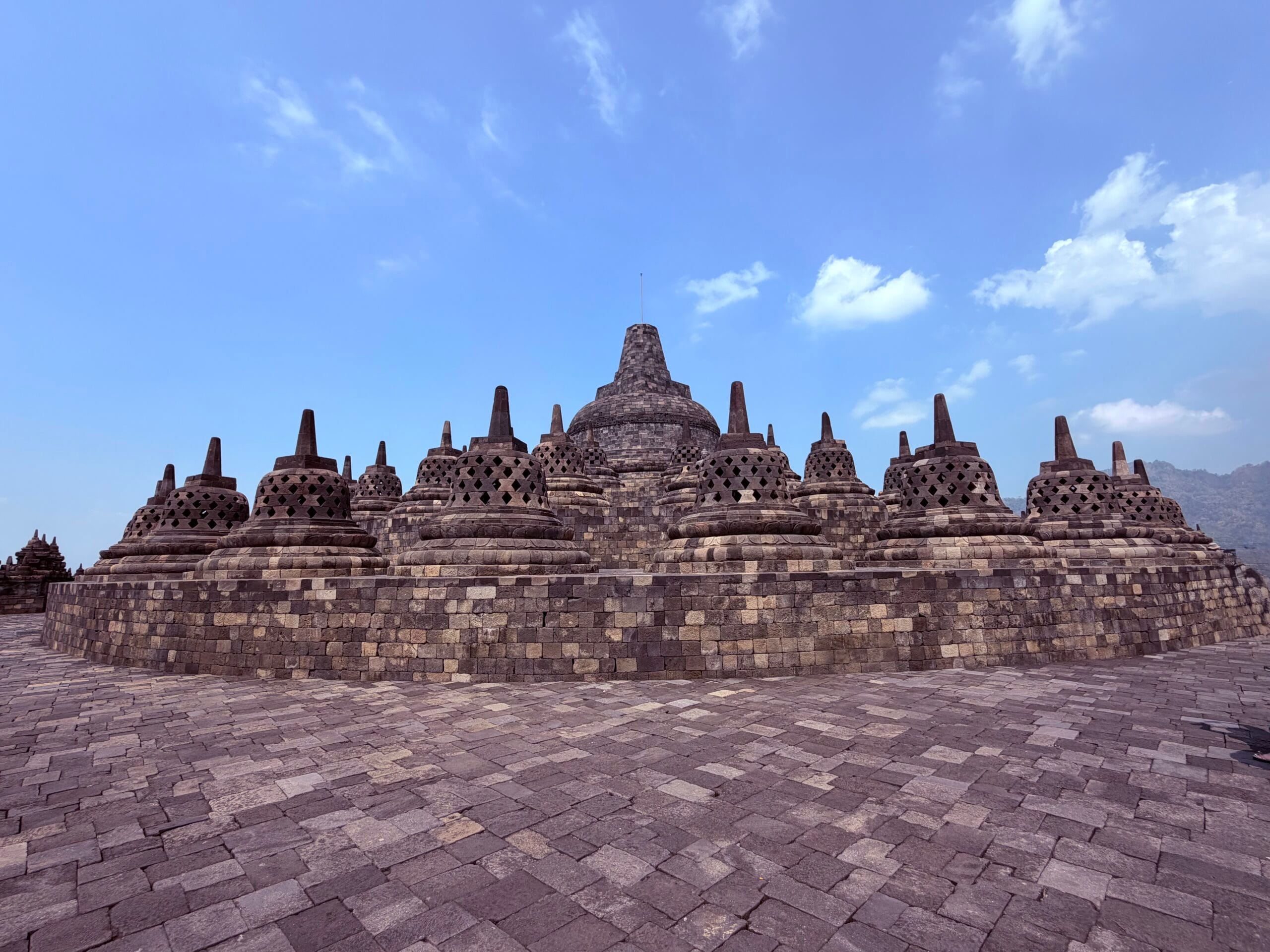
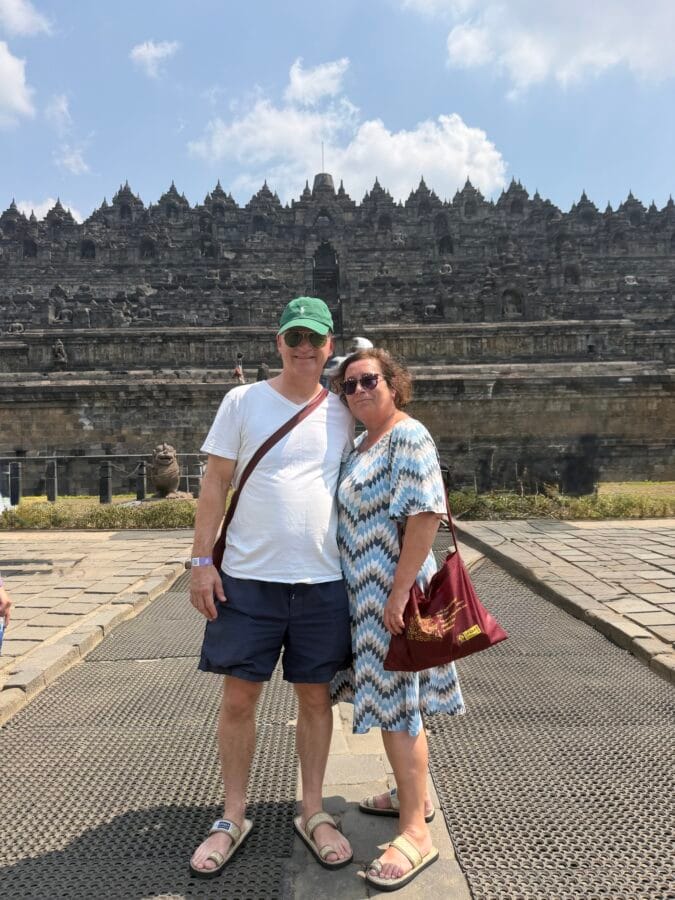
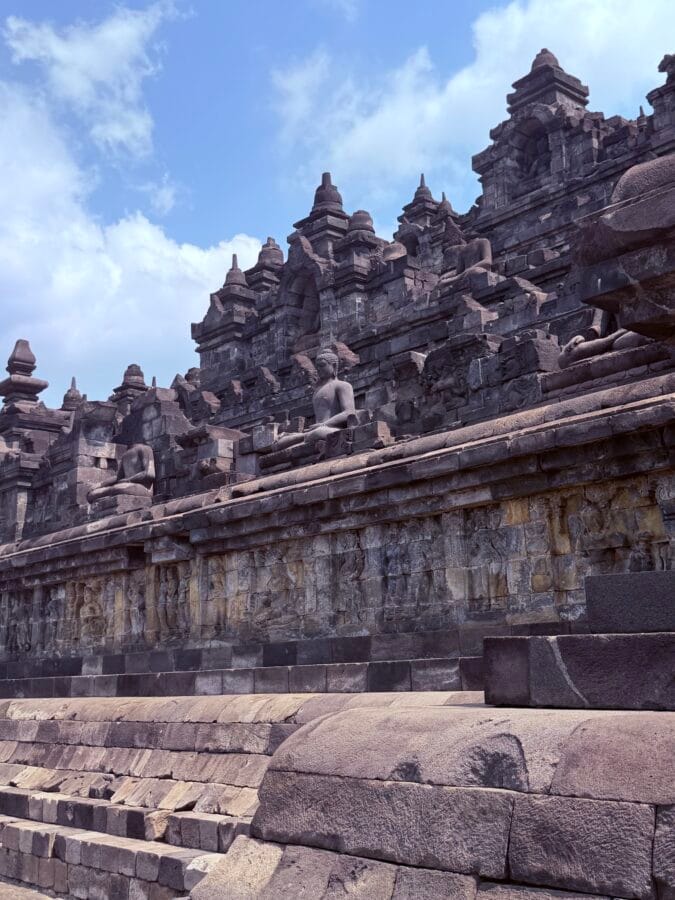
Our guide, a cheerful woman at least ten years my senior, took us along the road to the temple, telling us about the history of the monument as we went. I won’t go all Wikipedia on you. Suffice it to say that Borobudur is a massive, 1,200-year-old Buddhist monument made up of an astonishing amount of carefully stacked and carved volcanic stone. Its design represents the Buddhist path towards enlightenment, with ten levels leading upwards towards Nirvana. Seen from above, it looks like a perfectly symmetrical mandala.
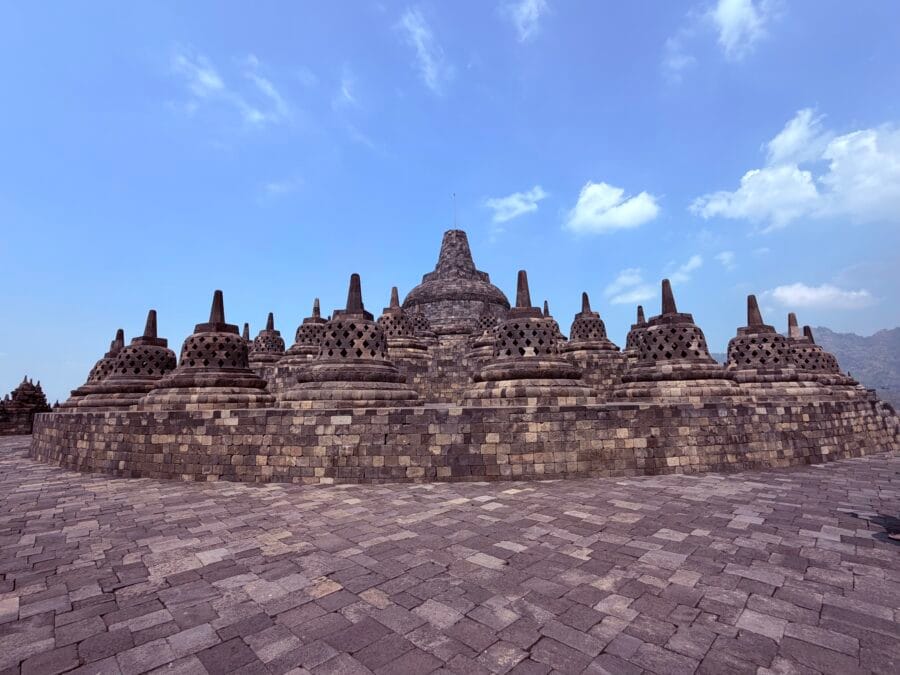
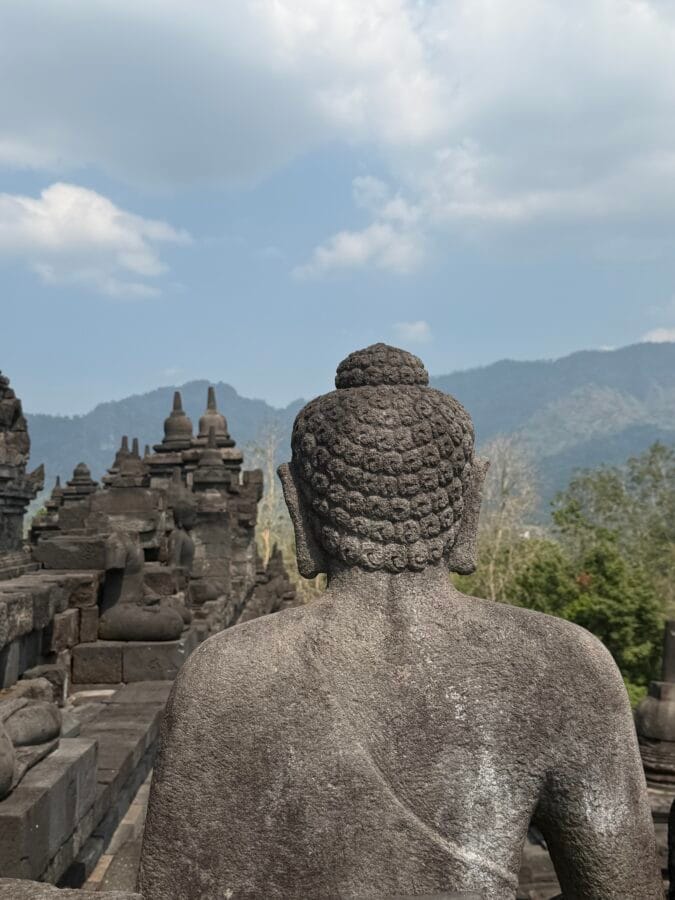
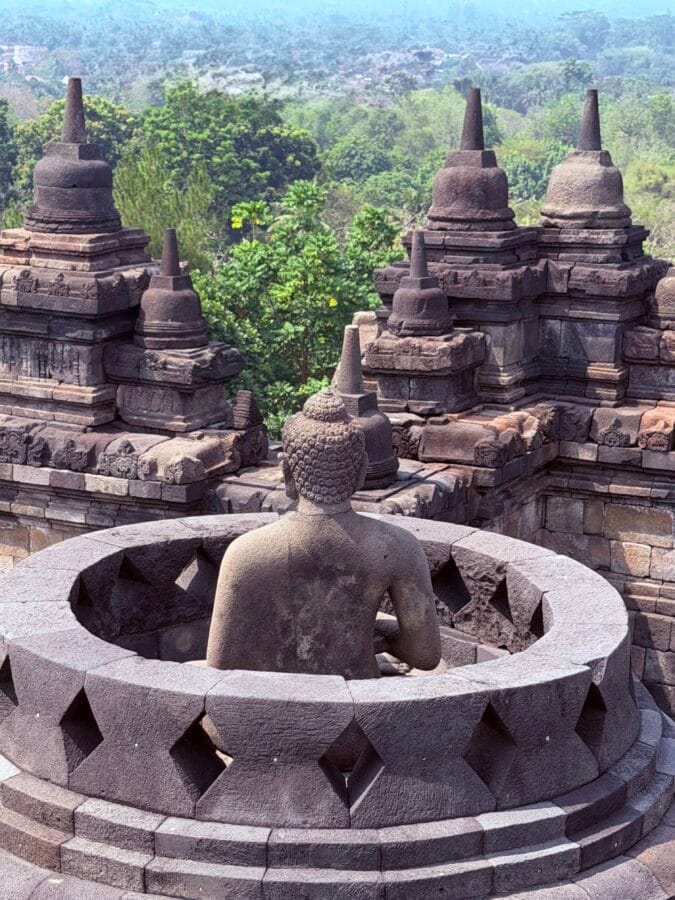
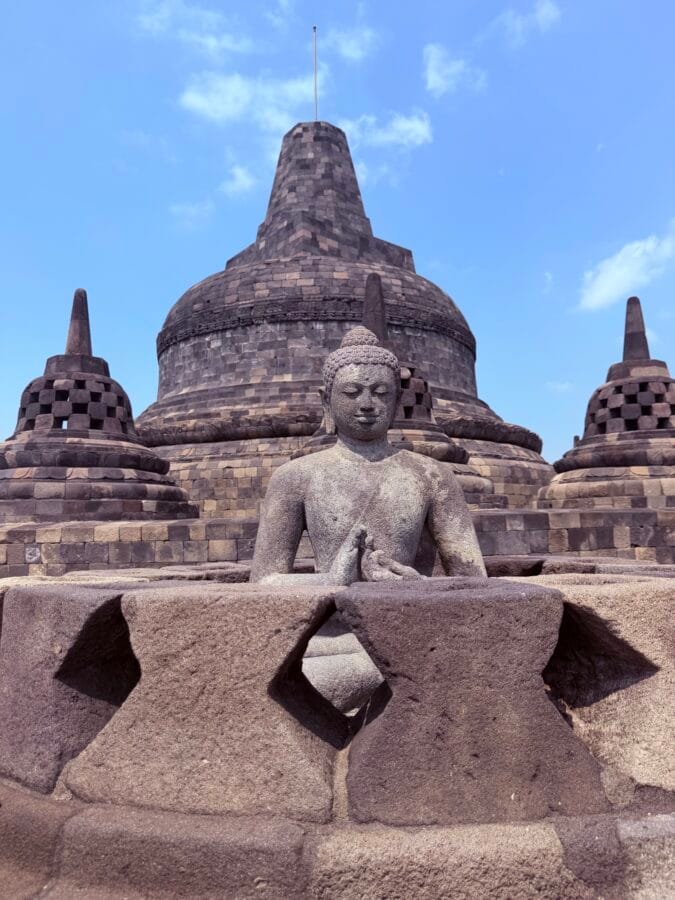
And then there are the stupas. Dozens of them sit on the upper terraces, each containing a Buddha statue. They look a little like enormous stone bells, with the Buddhas hidden inside them. The whole thing is quite extraordinary.
Borobudur was eventually abandoned and spent centuries buried under volcanic ash and jungle before it was rediscovered and excavated. Standing there now, surrounded by all that stone and detail, it’s difficult to believe that something this enormous was built more than a thousand years ago. It is incredibly beautiful. We took it all in for a moment before walking up to the monument. It was time to start the climb.
Turns out there are a lot of steps to Nirvana
Our guide told us how many steps there were to reach the top – more than I care to remember, but not nearly as many as at Bromo – and we started our ascent. Along the outside of the temple, because it is solid and there is no inside.
By the time we started the actual climb, it was the middle of the day and the sun was beating down on us. The heat was magnified by the fact that we were standing on black volcanic stone. It felt like it hadn’t properly cooled down after the last eruption. On the bright side, hardly anybody else was crazy enough to climb what felt like half-molten rock at 12 p.m. in the tropics, so we had the temple almost to ourselves.
Another plus was that our guide stopped at every level to show us the bas-reliefs on the sides of the temple, which tell the stories of Buddha. She compared it to a giant stone comic book, which is pretty much what it is.
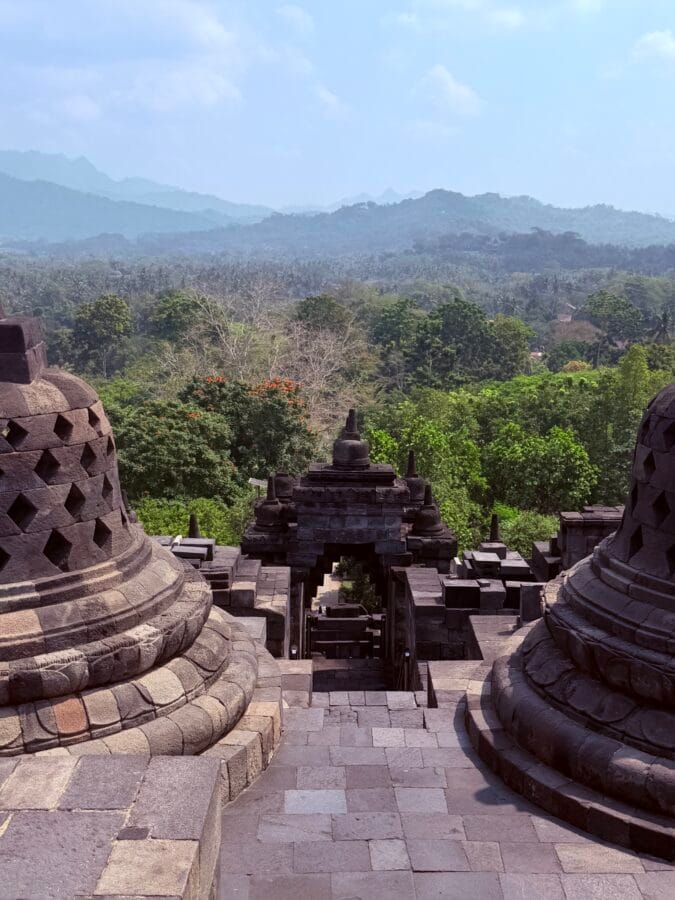
After about half an hour, we reached the top level of the temple, with all the stupas. We happily wandered around, taking photographs and admiring the view of the surrounding countryside. Unfortunately, Merapi, the volcano that has wreaked havoc on Borobudur more than once, was invisible because it was a hazy day.
Eventually, our guide left us at the bottom level of the temple and pointed us vaguely in the direction of the exit. That was not where we were supposed to go: we needed to fetch our bags, bikes and horses at the main entrance.
Of course, we promptly got lost.
Horses, bikes and a very good lunch
Finding our way back turned out to be slightly more complicated than expected. Several security guards kept trying to usher us and the Dutch family towards the exit, apparently assuming that if we were wandering around looking lost, we must surely be leaving. We passed the same spot more than once before finally working out where we were supposed to go.
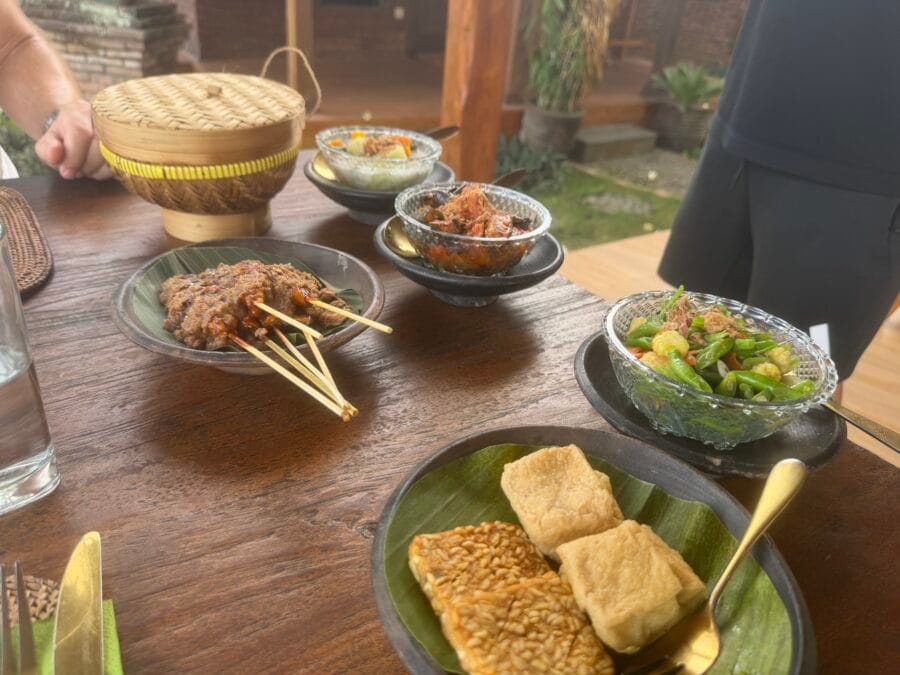
Eventually, we found the main entrance, collected our horse and carriage – and Marc’s bike – and made our way back to the little resort where the tour had started. There, we were rewarded with a lovely rijsttafel lunch, a spread of small Indonesian dishes served with rice, before getting back in the car for the drive to Yogyakarta.
And that was the end of our somewhat unconventional journey to Borobudur: bikes, horses, pottery, strange-looking goats, coconut sugar and, eventually, the actual temple itself.
Practical information: the Borobudur cycling tour
We booked this as a private, custom tour through our local tour operator, so unfortunately I can’t link to the exact tour we took. If you prefer a pre-organised tour, there are plenty of options available through GetYourGuide and other tour platforms.
So, would we recommend a tour with this exact set-up? Yes. It was a lovely way to reach Borobudur, particularly because it wasn’t simply a case of being driven to the temple and back. We cycled (well, Marc did) through the countryside, visited a pottery and a small palm sugar producer, met some goats, drank a frankly impressive amount of tea and, eventually, climbed Borobudur itself.
How difficult is the cycling?
Not very. The cycling is mostly flat and takes place on quiet roads through the countryside, so you don’t need to be an experienced cyclist to enjoy it. Marc, who happily cycles 100 km tours for fun, obviously found it extremely easy. I was still recovering from being ill, however, and appreciated the fact that the horse and carriage was an option.
If you’re reasonably fit and comfortable riding a bicycle, the cycling shouldn’t be a problem. The bigger challenge is likely to be the heat once you arrive at Borobudur.
What about the climb?
Climbing Borobudur is optional in the sense that you can buy a cheaper ticket that only gives you access to the park, but our tour included the climb. Only a limited number of visitors are allowed onto the monument itself each day, and everyone who climbs has to be accompanied by a guide and wear the special bamboo slippers provided at the entrance.
The climb itself took us about half an hour, including stops to look at the bas-reliefs. The final level, with all the stupas, is the highlight, and being able to wander around up there with relatively few other people was wonderful.
What should you bring?
Bring sun protection. Lots of it. The cycling is pleasantly shaded in places, but Borobudur is another matter entirely, particularly around midday. You’re walking on dark volcanic stone in full sun, and there isn’t much shade once you’re on the monument.
You don’t need to bring food or drinks into the park. Larger bags, food and drinks have to be left at the entrance, and you’re given a bottle of water when you collect your slippers.
Wear comfortable clothes and shoes suitable for cycling and walking. The bamboo slippers are provided for the climb, so you don’t need to worry about having special footwear for the temple itself.
Is this day trip for everyone?
I’d say it’s a particularly good option if you want to see a little more of the countryside around Borobudur rather than simply visiting the temple. The cycling isn’t strenuous, the stops give you a glimpse of local crafts and food production, and the horse-and-carriage option means there’s some flexibility if you don’t fancy cycling the whole way.
Just be aware that this is an early start and a fairly full morning. If your idea of a holiday involves sleeping until ten and having a leisurely breakfast, this probably isn’t the tour for you.
For us, though, it was a great day out. We got to Borobudur, but we also got a rather unexpected collection of goats, pottery, coconut sugar, horses and tea along the way. And honestly, that made the experience much more memorable.
Further reading
Planning a trip around Java? Take a look at our Java itinerary for our route, where we stayed and how we put the trip together.
If you’re interested in more day tours around Yogyakarta: here are six tours from Yogyakarta worth considering.
During our time in Yogyakarta we were based at the lovely Duta Garden Hotel. Definitely recommended.
For more Indonesia, take a look at my Indonesia travel guide.