Accessible Panorama Route day trips near Kruger Park
The Kruger area: more than just lions
Looking for accessible Panorama Route day trips near Kruger Park? After a few days of safari, this route offers waterfalls, viewpoints, and scenic stops that suit a more relaxed pace. From the famous Panorama Route to waterfalls, viewpoints, and relaxed sightseeing stops, these non-safari excursions add variety to any Kruger itinerary without sacrificing comfort.
That’s exactly what we were looking for after five days in the bush: not less safari, just something different for a day. And staying nearby made the decision easy. Panorama Route it was! However, there were a few more decisions to make: would we drive or join a tour, and where would we stop along the way? In the end, we decided on a self-drive with stops at five highlights.
A quick note on road conditions
Road conditions on this route can change quickly, especially after rain, so it’s worth asking your guesthouse or lodge for the latest local advice before you set off. When we drove it, the main issue was potholes rather than navigation, and we were glad to be doing that first stretch in daylight.
Jump to a section
Panorama Route Decision Guide
Not sure whether to self-drive, book a tour, or which stops are easiest to access? This quick guide covers both the practical choice and the mobility side of the route.
Self-Drive or Guided Tour?
Self-Drive
Our choiceBest if you want maximum flexibility and do not mind driving yourself.
Most flexible, usually cheaper, and easy to linger longer at favourite stops.
Potholes, navigation, road signs, and a more tiring day behind the wheel.
Independent travellers who enjoy freedom and setting their own pace.
Guided Day Tour
Best if you want an easier day with less planning and helpful local commentary.
No driving stress, simpler logistics, and more context from a local guide.
Less flexibility, fixed timings, and a higher price than doing it yourself.
Travellers who want a stress-free, informative day out.
At-a-Glance Access Guide
Use this to decide which stops are easy to reach, and which ones take a bit more effort.
Easiest access
-
Lisbon/Berlin Falls
Flat, paved, very short. Effort: 1/5
Suitable for limited mobility. Park right at the viewpoint. -
Graskop Gorge Lift
Elevator access plus flat boardwalks. Effort: 1/5
Suitable for limited mobility and one of the easiest options. -
Three Rondavels
Mostly flat, paved pathways. Effort: 2/5
Suitable for limited mobility, with only a slight incline.
Manageable, but more effort
-
Bourke’s Luck
Paved, but with steeper inclines. Effort: 3/5
Less suitable for limited mobility because of slopes and uneven sections.
Best skipped if easy access matters
-
God’s Window
350+ steep stone steps. Effort: 5/5
Not suitable if you want an easy-access stop.
The Panorama Route: our self-drive experience
Three Rondavels: the best views for relatively little effort
Armed with local advice and a packed lunch from our guesthouse hosts, we set off along the Panorama Route. Marc took the wheel, as always, expertly dodging potholes big enough to hide a respectable elephant in. Especially the stretch from Hazyview to the actual start of the Panorama Route was bad. In daylight, the first stretch is perfectly manageable; in the dark, much less appealing. As soon as we got to the road where all the tourists drive, things got better.
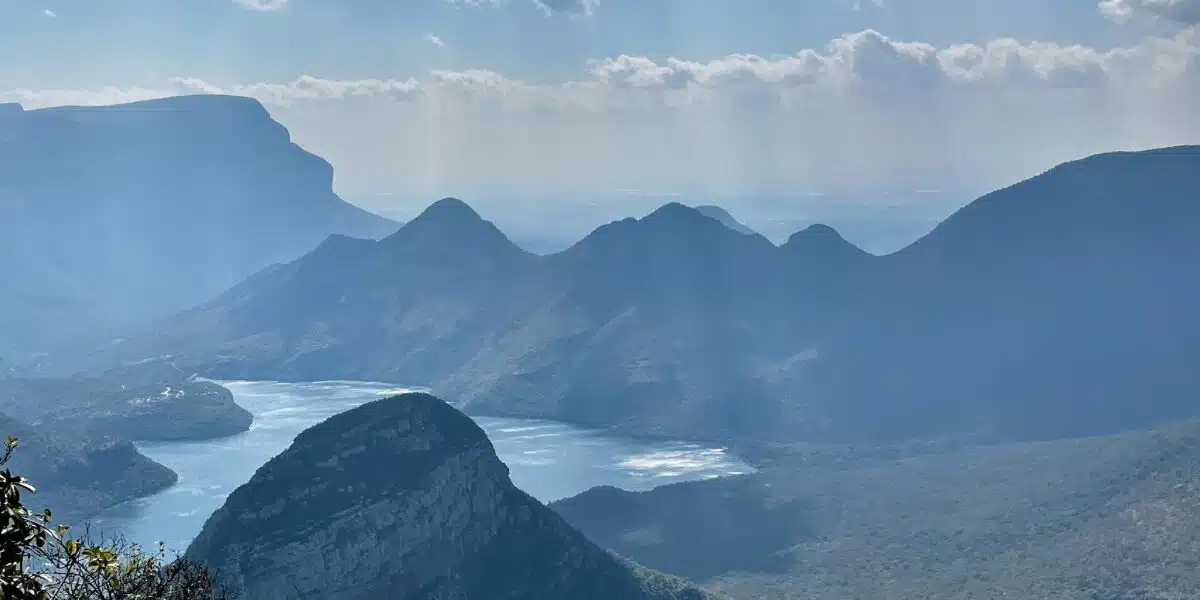
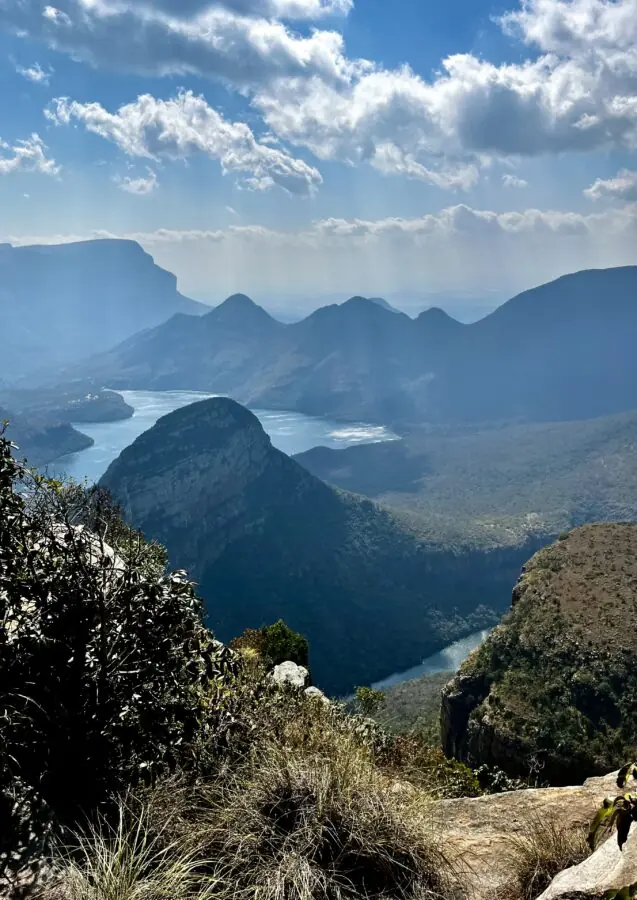
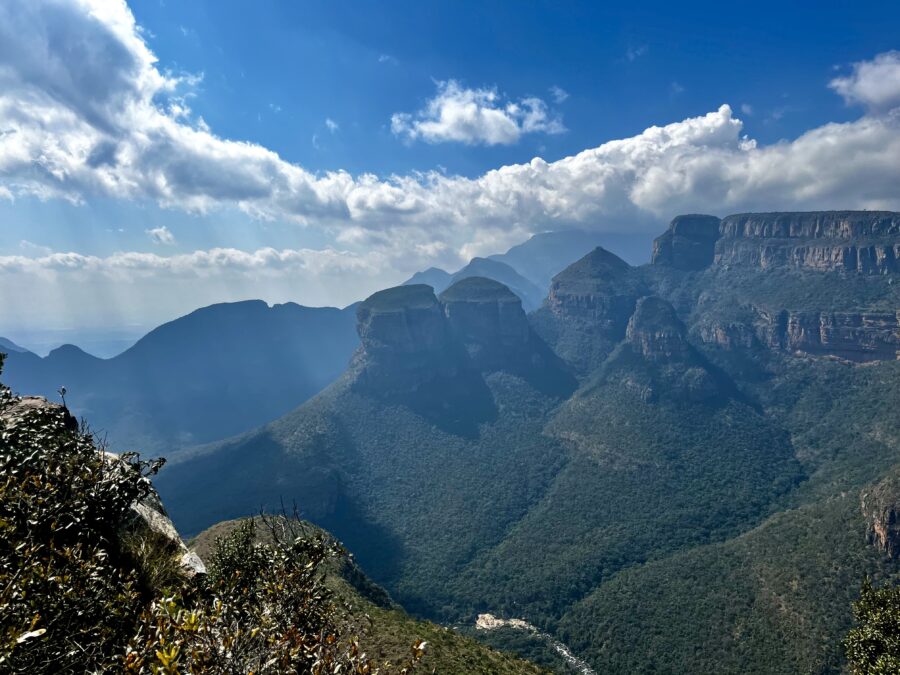
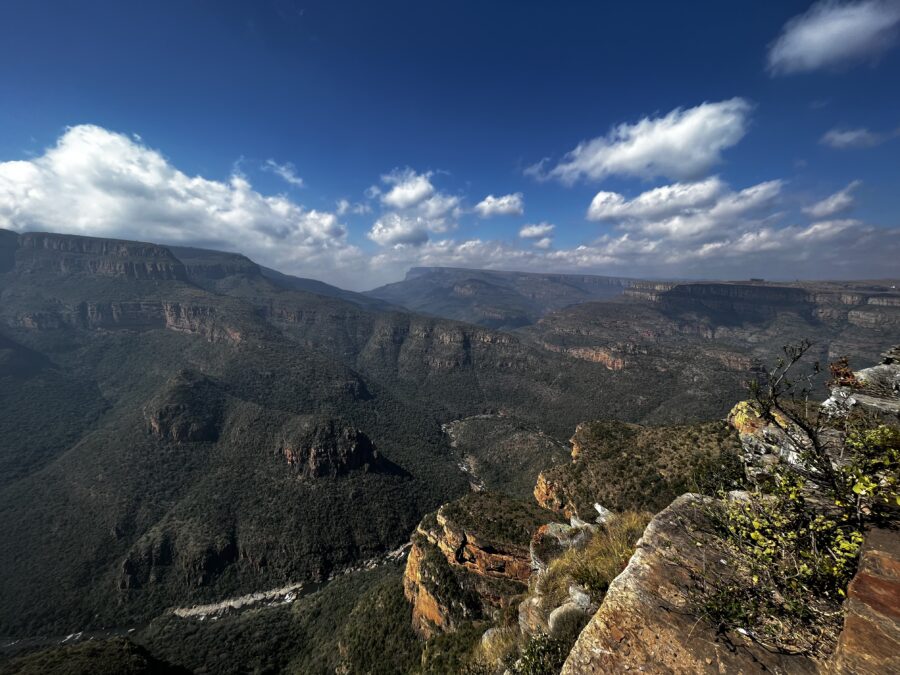
Following our hosts’ advice, we drove straight to the farthest point first: the Three Rondavels and the views over Blyde River Canyon. That gave us the best chance of arriving before the weather turned (which it often does) and before the tour buses rolled in. Blyde River Canyon is the third-largest canyon in the world, after the Grand Canyon in the US and Fish River Canyon in Namibia. It is also the only one of the three that looks properly green rather than all rock and drama. The Three Rondavels are mountain peaks shaped like rondavels, the traditional, round, thatched huts found all over southern Africa. Helpfully, there are indeed three of them.
The views over the canyon are just a short walk from the parking area, followed by a bit of light scrambling over rocks and several viewpoints designed for staring into the distance and declaring things “absolutely stunning.”
All in all, it was the ideal first stop: spectacular, easy, and accomplished before the rest of the world had properly arrived.
Bourke’s Luck Potholes: doable, but more demanding
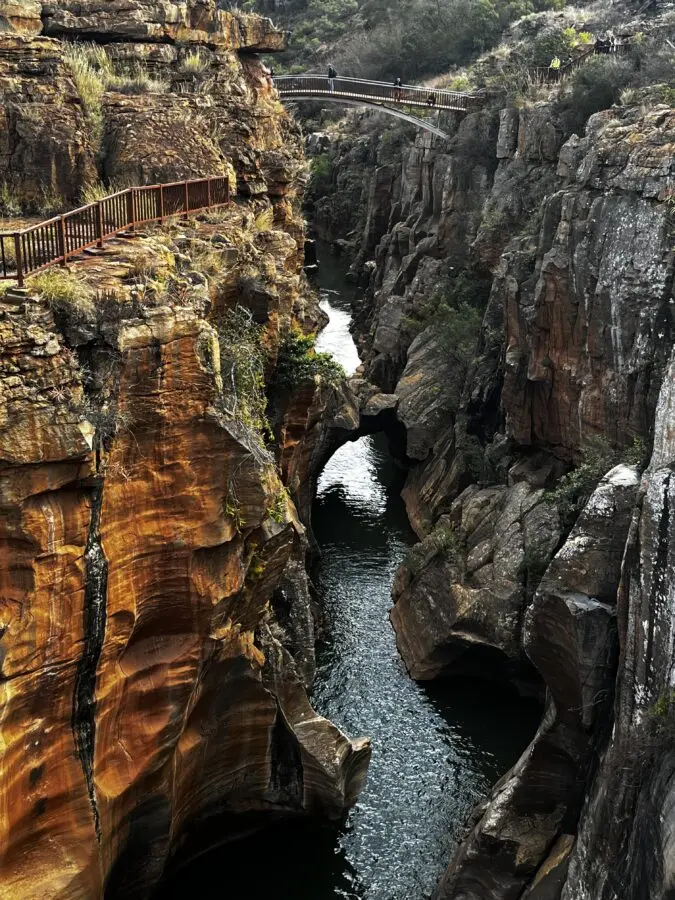
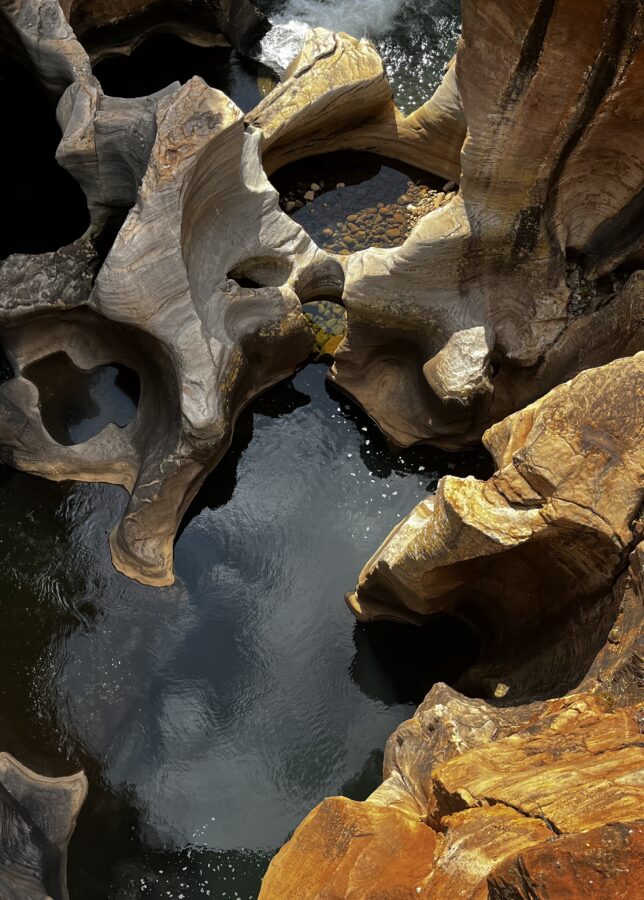
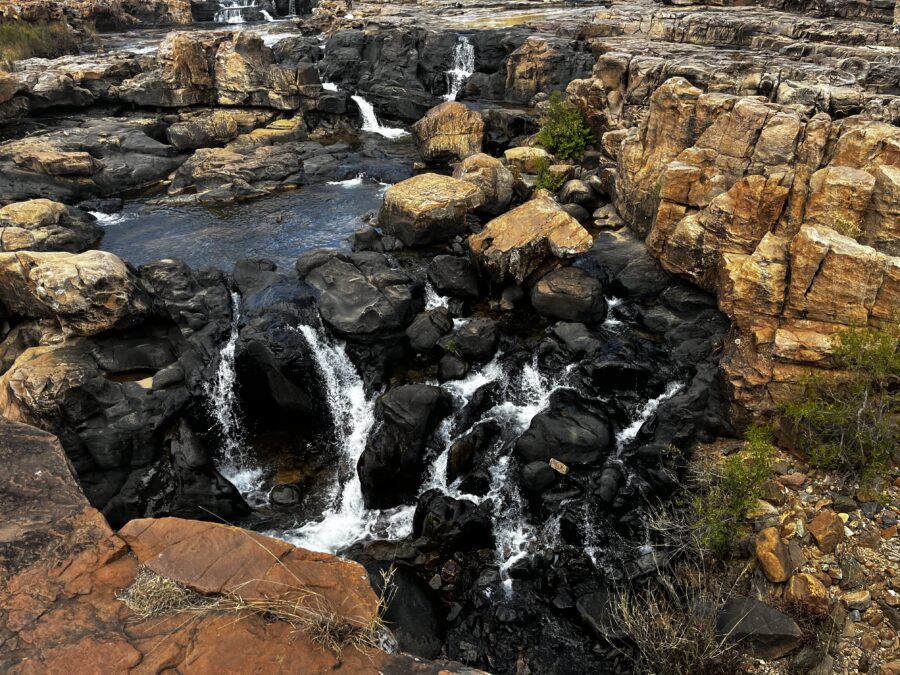
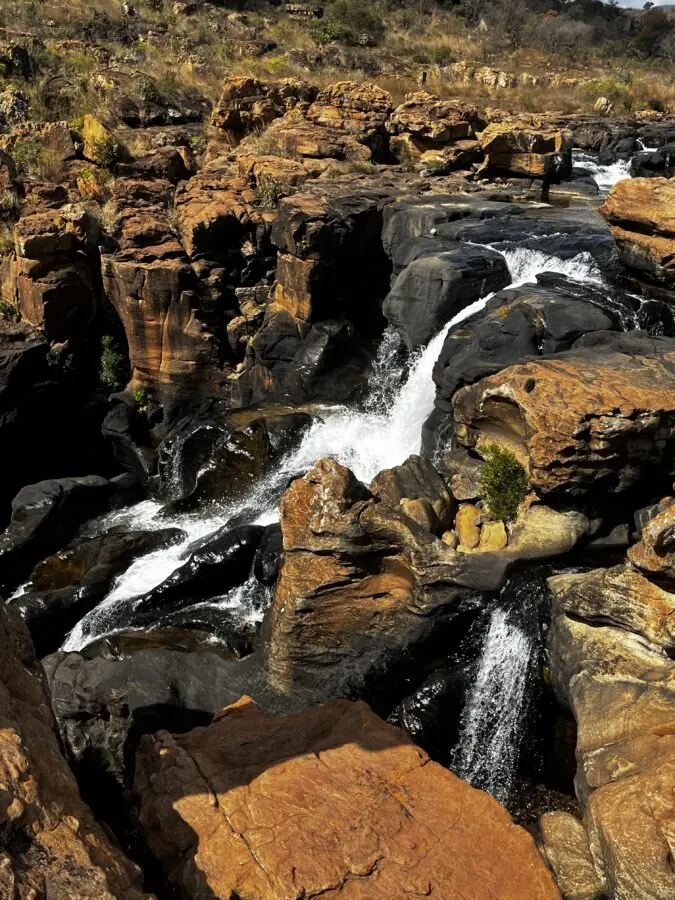
If you only have time for one stop between the canyon at the end of the road and the waterfalls at the beginning, make it this one. It’s where the Blyde and Treur rivers meet in a violent swirl, and over a few million years, the water has literally bored deep, perfect cylinders into the red sandstone. Unlike the potholes in the roads, these are beautiful and you don’t run the risk of driving into them. There are paved paths and metal bridges leading to wonderful viewpoints.
Now, the guidebooks love to use the word “paved,” which sounds lovely and flat, right? Well, not quite. While the path from the Visitor Centre is indeed paved, it’s a bit of a deceptive trek. It’s about a 700-meter wander down to the bridges, and while gravity is your friend on the way down, that return trip to the car park is a steady, uphill climb that’ll definitely remind you that you’re at altitude. If you’re sure-footed and reasonably fit it is entirely doable, but I wouldn’t recommend the full loop to people with walkers or needing a wheelchair.
Once you’ve made your way down, you will be rewarded with spectacular views from the bridges and walkways. You’re standing right over the thundering water, looking straight into these deep rock wells. If you decide to leave the paths and bridges, which we did for some more rock scrambling and jumping over streams, watch your footing. The rock surfaces near the water can get as slick as ice if there’s been a bit of mist or rain.
If your knees (or any part of you) are feeling their age, take it slow. The museum at the entrance is flat and fascinating, but the potholes themselves require a bit of “mountain goat” energy. It was worth every step though so if you can, go and see it.
God’s Window: skip this one if easy access matters
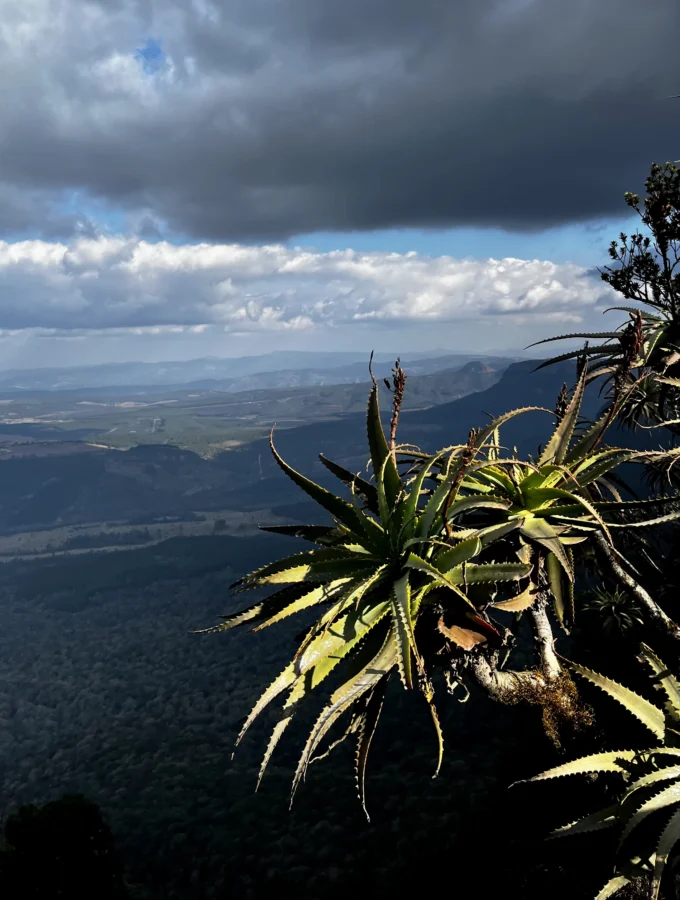
If you are running behind schedule, this is the one stop I’d give a miss. While the name sounds divine, the reality is often a bit of a gamble. God’s Window has a massive ego and loves to hide behind a thick wall of white mist, meaning you can pay your entrance fee and walk to the edge only to see a giant gray cloud. On a clear day you can see forever, but once you’ve seen the Three Rondavels, you’ve already seen the best views of the day.
Even on a clear day, the “real” experience involves a humid, lung-busting climb through a patch of rainforest to reach the highest viewpoint. You’re looking at approximately 300 to 350 steep stone steps to get to the top. Honestly, the view up there is only about 10% better than the one from the lower parking lot decks, but the effort is 100% higher. Yes, the views are beautiful. Just not 350-steep-steps-through-the-rainforest beautiful.
Lisbon and Berlin Falls: the easiest waterfall stops
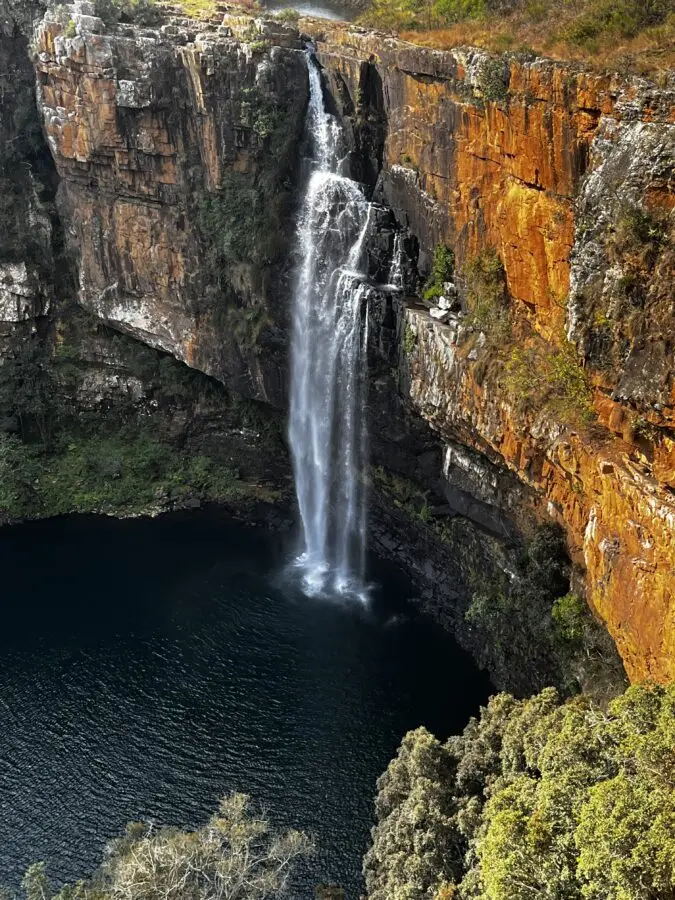
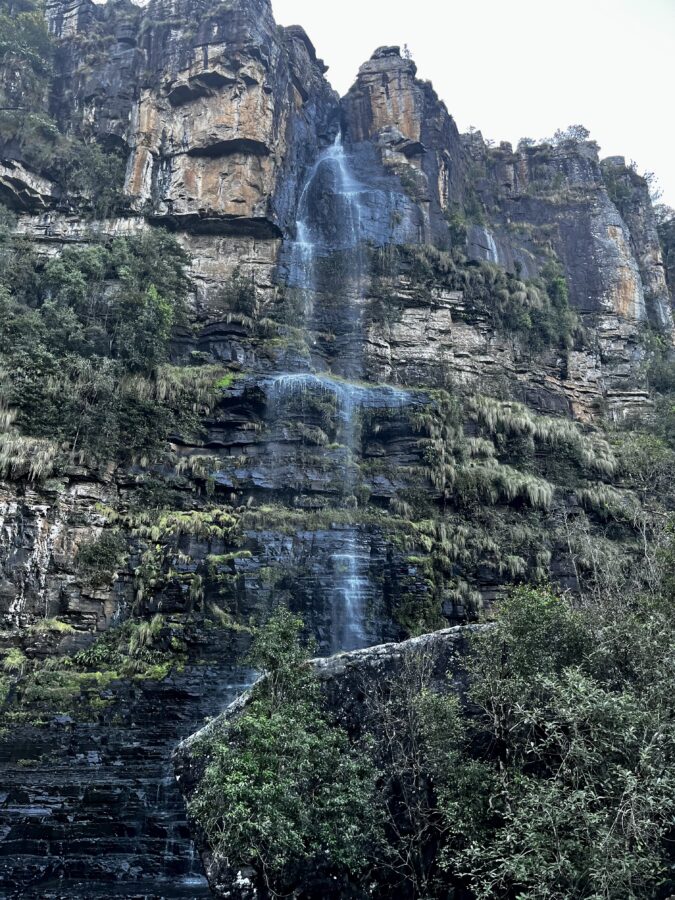
If God’s Window is the high-effort gamble, Berlin and Lisbon Falls are the low-effort rewards. These are the perfect “short stops” for your itinerary because they offer maximum drama with almost zero climbing. Lisbon Falls is the tallest in the province, a spectacular 94-meter double-drop that hits the basin with a thunder you can feel in your chest. The best part? You can see the whole thing from a viewpoint just a few meters from where you park your car.
A few minutes down the road, Berlin Falls looks like a giant white candle, pouring through a natural rock “wick” into a deep green pool. Again, it’s a flat, easy stroll from the parking area to the observation deck. Both stops usually cost a nominal R10 or R15 entrance fee, which is a bargain for a world-class view that doesn’t require a single one of those 350 stone steps we mentioned earlier. If you’re self-driving, these are the perfect spots to stretch your legs, snap a few high-quality photos, and be back on the road in less than twenty minutes.
The Graskop Gorge Lift: accessible adventure
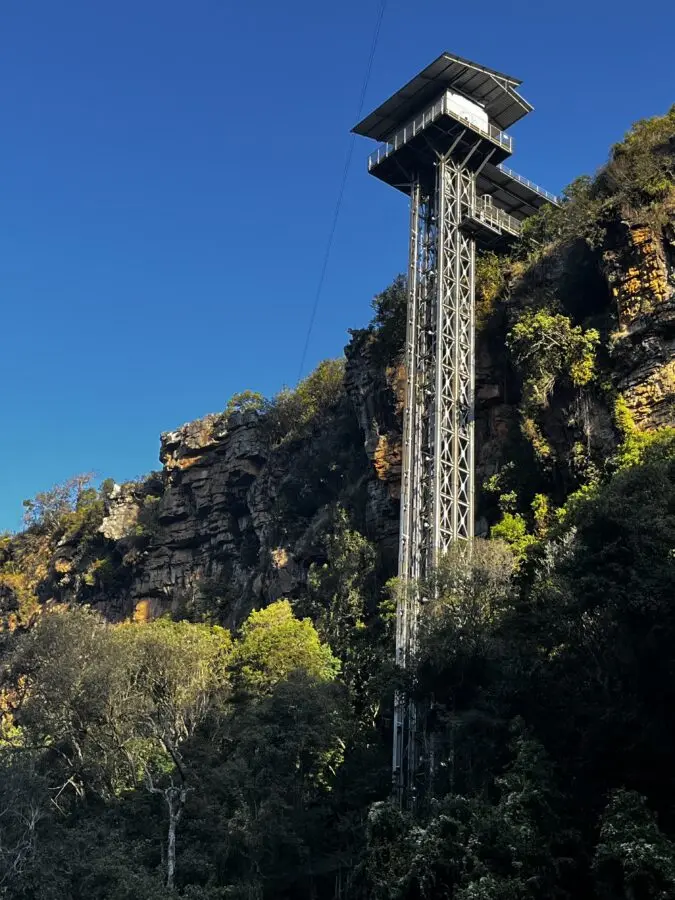
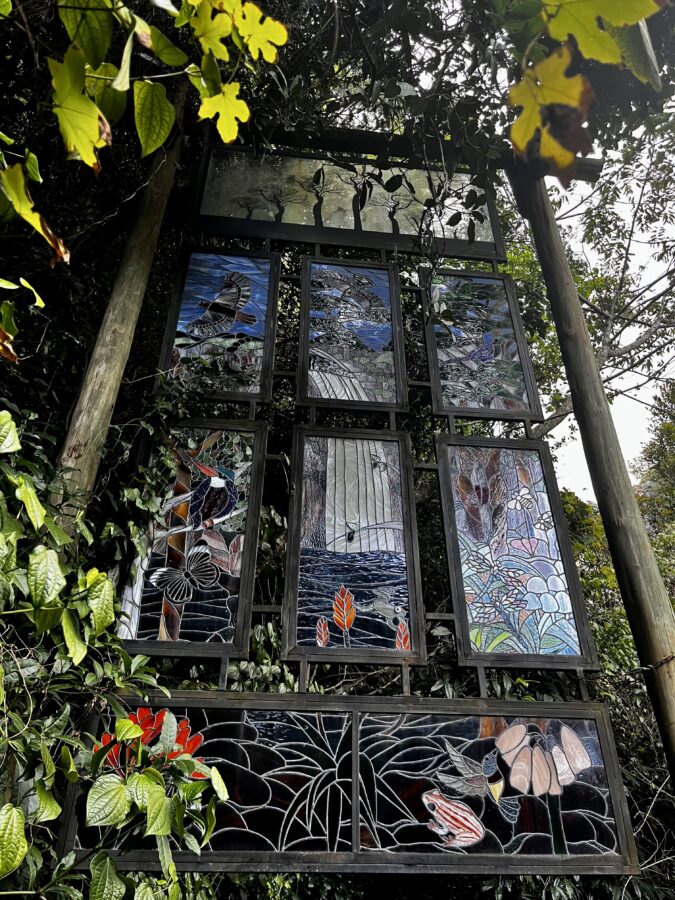
This is the one with low effort and high reward. You glide 51 meters down the cliff in a glass elevator into a prehistoric forest. At the bottom, a flat 600-meter wooden boardwalk winds through the trees. It’s peaceful, it’s shaded, it has lots of signs about birds to read. This is where you’ll find the small suspension bridges crossing the streams.They are rock-solid, but we had the best time jumping up and down on them like much (much) younger people.
Back at the top, make sure you walk across the main bridge that spans the gorge. It’s 52 meters of “walking on air” with incredible views. From here, you can see the Graskop Falls tumbling like a delicate white veil into the abyss. You’ll also hear the screams from the Big Swing, where people free-fall 70 meters across the canyon. It looks terrifying to do, but entertaining to watch from the safety of the café deck with a cold drink in hand.
Where to refuel: the best stops for coffee and pancakes
The classic: Harrie’s Pancakes (Graskop) You haven’t actually done the Panorama Route until you’ve sat at Harrie’s. It’s casual, nostalgic, and the service is lightning-fast. Order the savory biltong and cheese pancake followed by a sweet black cherry one. It’s a tradition for a reason.
The fancier choice: Abe’ at The Glass House For a proper sit-down dinner once you’re back in Graskop, this is the spot. Abe is a local legend, and the vibe is intimate and warm. Their steaks are arguably the best in the province. Perfect for reflecting on the day’s views over a bottle of South African red.
Beyond the Panorama Route: other non-safari day trips near Kruger Park
If you need a break from game drives but cannot quite face a full Panorama Route day, there are a few other options nearby. They are a slightly random assortment, and not all of them are especially straightforward, but depending on your mood, one of them may appeal.
Blyde River boat tour
If I were choosing an alternative, this would probably be the sensible option. It is scenic, slower paced, and involves far less getting in and out of the car like you have lost your glasses in the footwell again. If you want a quieter day with good views and minimal nonsense, this is the one I would look at first.
Hot-air balloon flight
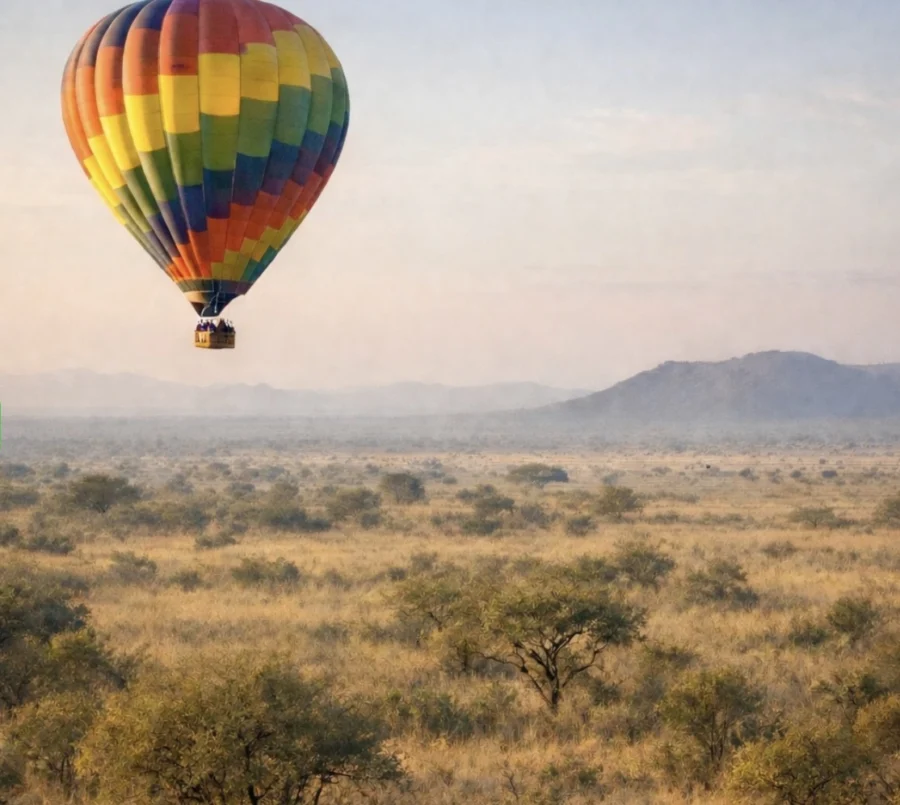
This is less a practical excursion and more a “well, this feels rather fabulous” sort of outing. It is the kind of thing you book because it sounds memorable and slightly ridiculous in a good way. That said, it does involve an early start, which is all terribly romantic until the alarm goes off.
It is worth knowing that this is not quite as effortless as simply stepping into a basket and drifting off into the sunrise. Getting in usually involves climbing over the side of the basket, and both take-off and landing require you to be reasonably steady on your feet.
Horse riding
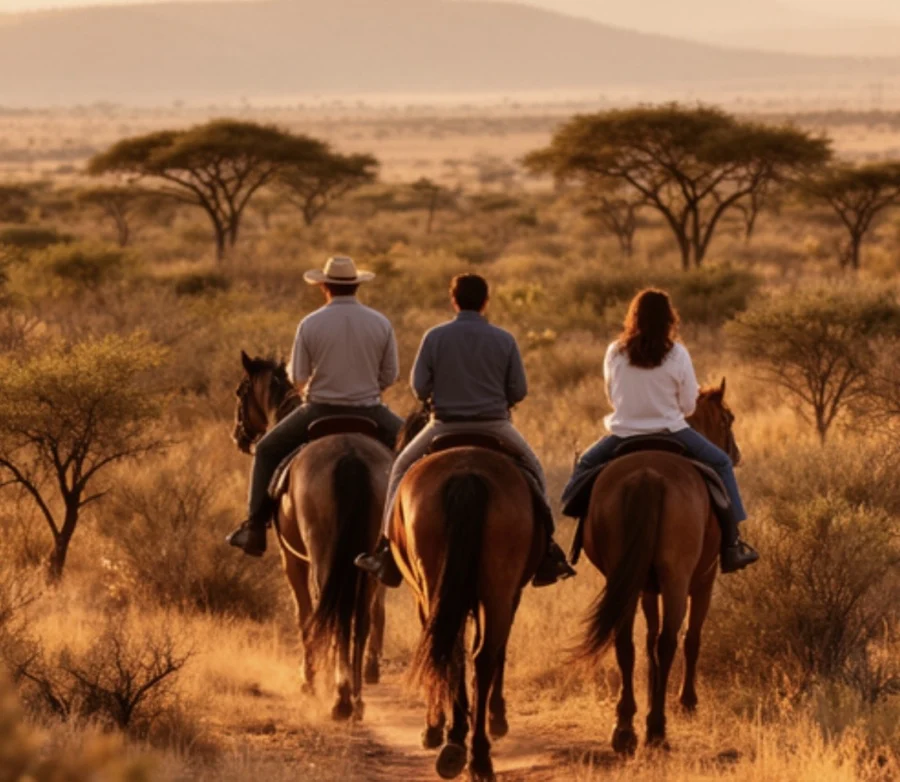
This is more of an active option and probably one for people who genuinely enjoy horse riding, rather than those who simply like the idea of looking good in the photographs. It is not especially low-effort, but if you want something different from waterfalls and viewpoints, it could be a good change of scene. Not for me – I still believe the front end of a horse bites, the back end kicks and the middle is uncomfortable.
For people who find scenic viewpoints insufficiently dramatic
If driving scenic routes and admiring canyons from sensible viewpoints still leaves you feeling under-stimulated, the Kruger region does, thankfully, have other ideas. Near Hazyview, you can go white-water rafting on the Sabie River, which involves a series of grade 2 to 3 rapids and a reasonable chance of getting wetter than planned. There are also zipline options, including an aerial cable trail over the Sabie River valley and a shorter but more theatrical one at Graskop Gorge. And if even that all sounds a little restrained, there is always the Big Swing at Graskop Gorge, which appears to have been designed for people who look at a perfectly nice gorge and think: yes, but what if I jumped into it.
For us, the Panorama Route was still the best non-safari day out from Kruger. It offered the most variety, the clearest choice between easier and more demanding stops, and the least sense of spending the day wondering whether this was all a bit too much. But if you have extra time, or simply fancy a change, one of these could be worth a look.
Final thoughts: crafting your perfect break from safari
A trip to Kruger does not have to be safari all day, every day. In fact, depending on your interests, energy levels and tolerance for both early mornings and uneven surfaces, it may be all the better for a bit of variety. One day you can be looking out over Blyde River Canyon, the next drifting along the river on a boat or deciding, for reasons known only to yourself, that a quad bike is an excellent idea.
Safari may be the headline act, but the supporting programme is stronger than you might expect.
This trip was part of our three-week South Africa itinerary, with a mix of city visits, road trips, wine tasting and of course, safari.
Look here for our full South Africa safari guide, in case you want to go back to safari after the beauty of the Mpumalanga Region.
For all things South Africa, have a look at our 55+ South Africa guide.