Can I really climb Mount Bromo? Apparently, yes.
The 3 a.m. question
We fell asleep embarrassingly early the night before our Bromo sunrise excursion. This wasn’t because we were particularly sensible about our bedtime; we’d spent the day on a walking tour of Malang before heading off on the Madakaripura Waterfall adventure, and by the time we got back we were completely wiped out. Then came the small matter of a 3 a.m. alarm. I had my doubts. Quite considerable doubts, in fact, about whether I was going to make it up Mount Bromo at all. The crater sits at around 2,300 metres, and while that isn’t particularly high by volcano standards, the climb itself involves a combination of volcanic ash, a fairly steep slope and, eventually, a staircase apparently designed to deter non-whippet-shaped middle-aged travel writers.
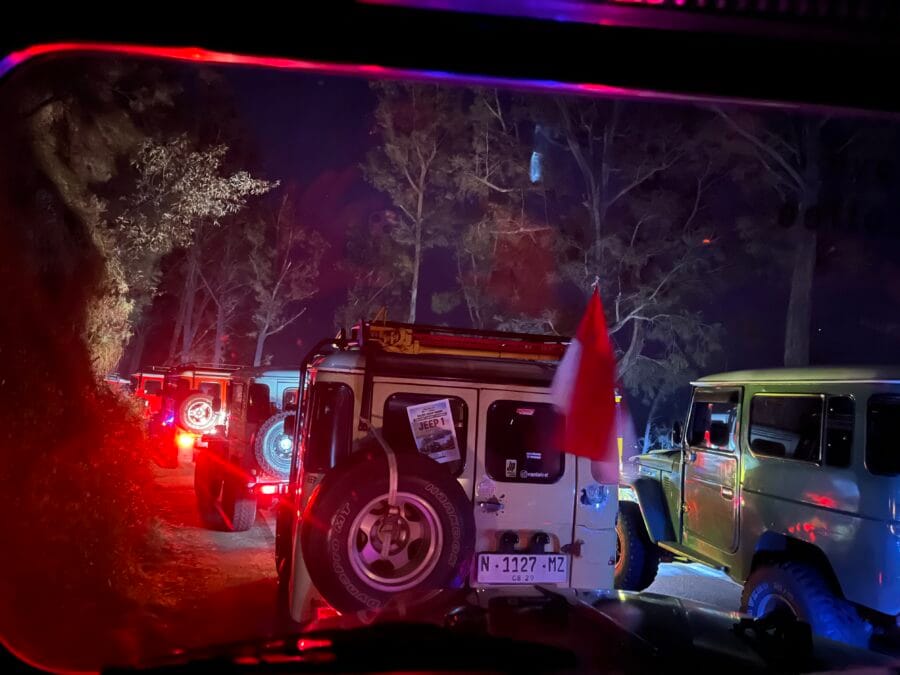
But at 3 a.m., somehow, we were awake, dressed and stumbling around in the darkness looking for our Toyota Landcruiser. We found it, climbed in, and joined the procession towards the viewpoints. It looked like every single Toyota Landcruiser on the planet had arrived in East Java, and all of them were heading in exactly the same direction. A coworker who was also in Java at the time later informed me that only half of all the Landcruisers were on the road to Bromo: the rest were apparently over at Mount Merapi.
Just here for the practical stuff? → Jump to Practical Considerations
Mount Bromo at a Glance
Start time: Around 3 a.m.
Sunrise viewpoint: Kingkong Hill
Duration: About 7 hours
Difficulty: Strenuous, but not technical
Main challenge: I call them the Stairs of Doom for a reason.
What to bring: Warm layers, water & good shoes

Kingkong Hill and the sunrise
Eventually, the traffic came to a complete standstill. The drivers abandoned their vehicles where they were, and everyone got out and continued on foot. We had about 2 kilometres uphill to Kingkong Hill, where we were hoping to catch the sunrise.
It was still completely dark, so for the first part of the walk there wasn’t much to see beyond the people around us, a few million stranded Landcruisers and the occasional torch lighting up the path. The walk was perfectly manageable, although the final stretch up to the viewpoint gave me my first indication that Bromo might require a little more effort than I had hoped. We arrived at the viewpoint on Kingkong Hill just before the sky began to lighten.


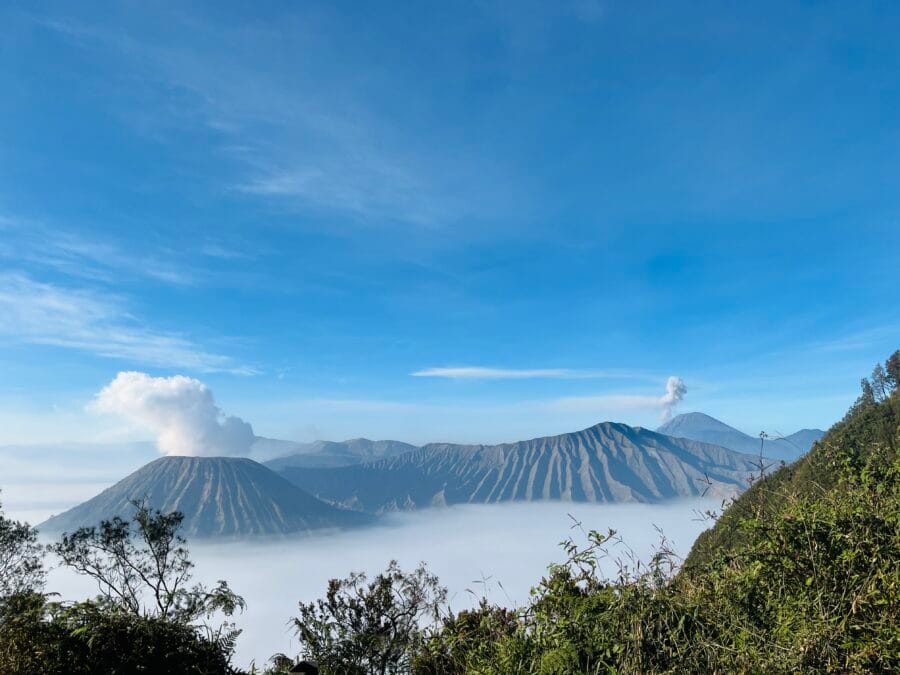
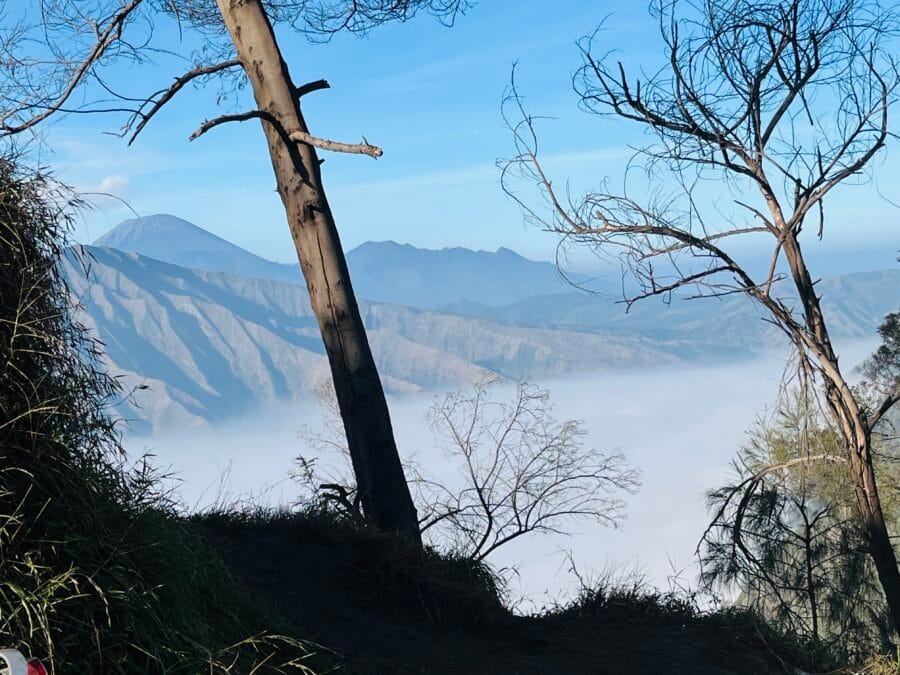
Slowly, the darkness lifted and the volcanoes emerged from the landscape. Mount Bromo, Mount Batok and Mount Semeru appeared as the first light reached them, and suddenly the early alarm, my slightly displeased legs and the chaotic journey up the hill seemed entirely justified.
We were not the only people enjoying the view. There were crowds on the hill, some with cameras, some with drones, and quite a few wrapped up against the cold. There were also people selling coffee and jackets, and several of them looked at me with what I took to be a mixture of concern and pity.
I was wearing shorts. This was not, as several people seemed to assume, a bold choice. I’d simply left my only pair of long trousers behind in Sumatra. The coffee and jacket sellers were therefore considerably more prepared for Bromo than I was.
But the cold was a small price to pay. As the sun rose higher, the volcanic landscape became clearer and clearer, and I stood there taking it all in, suddenly very glad that we’d got out of bed.

The Sea of Sand, the Stairs of Doom and the crater.
The Sea of Sand
Once the sun was up, it was time to get back to the jeep for the second part of the adventure: climbing Bromo itself. The walk was downhill and, thankfully, not in the dark this time, and in no time we found our driver, sound asleep. He turned the jeep around, we got in, drove for about 500 metres and came to a complete standstill again. This gave us time to admire the scene in broad daylight.

Being relatively far down the mountain, which had been rather annoying when we were walking up, was now a blessing: we weren’t stuck in the traffic jam for long. We had time to get out for a cup of coffee from one of the vendors before the jeeps started moving again, and off we went, into the crater. This was where things started getting decidedly Mad Max. Huge numbers of jeeps were racing through the sand towards the goal: the car park. It was all very exciting. And very dusty.


We got out of the jeep, our driver pointed us in the right direction and told us we could ride a horse if we didn’t want to walk. I did not particularly want to walk, but I also didn’t want to make a horse do the hard work for me. If I couldn’t make it up to the crater on my own two feet, I simply would not get to see the view from the crater rim. I was, however, determined. I’d already missed Sibayak because of illness; I wasn’t going to let some volcanic ash and a few stairs get in the way of seeing the inside of a volcano.
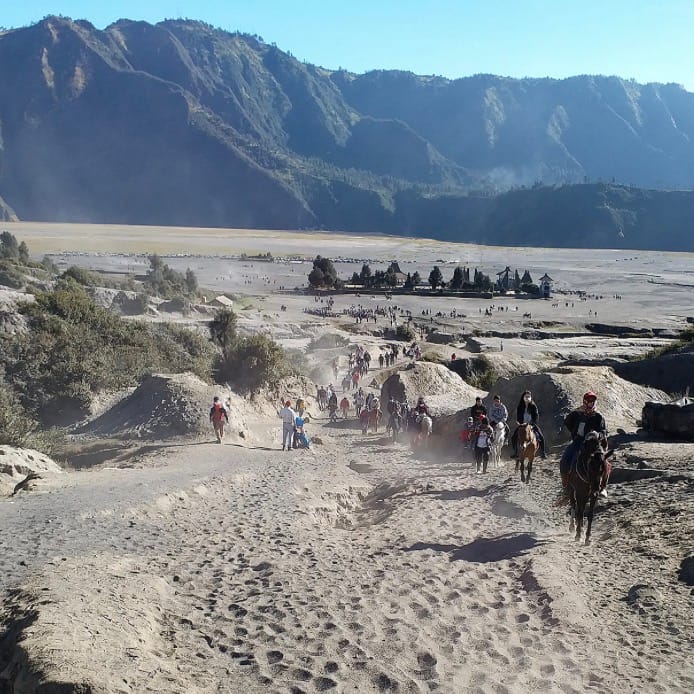
The start wasn’t too bad: a flat walk through a comfortably thin layer of ash. People all around us were getting on horses while we walked smugly towards the volcano. The smugness did not last long. By the time the ash had deepened to at least ten centimetres and the incline was more Everest than leisurely stroll, getting on one of the horses started to look decidedly tempting.
I persevered, though. Thigh muscles and lungs protesting, I made it up the hill. Marc, who had of course skipped up the incline like the overly fit mountain goat that he is, was waiting for me.
What was also waiting for me: the Stairs of Doom.
The Stairs of Doom
They are not, as far as I know, actually called the Stairs of Doom. They should be. They were absolutely diabolical. I lost count somewhere around the middle, but I’ve since been told there are 245 of them. The bad news was that every single one involved a fairly substantial step upwards. The good news was that they were well maintained, there was a handrail and, every now and again, there was a “viewing platform”. This was not so much for viewing as for catching your breath.
I managed to skip the first platform, but after about 100 steps I could no longer pretend that I was going to make it to the crater rim without a single pause. From there on, I was taking the stairs in instalments, usually managing 20 or 25 steps before stopping for a breather. By the final stretch, even that was becoming optimistic. Was I dragging myself up by the handrail for the final bit? Possibly.
I wasn’t alone in my suffering. People thirty years younger than me were huffing and puffing their way up too, which made me feel considerably better about my own performance and considerably less impressed with the fitness level of the average Bromo visitor. At least I wasn’t the only one finding the stairs a challenge. But eventually, one step at a time, I made it to the top

The crater rim
I arrived at the crater rim and promptly sat down. This was only partly to recover. I was also slightly concerned that, standing right on the edge, I might topple backwards into the volcano. There was a fence post next to me, so I grabbed hold of it and stayed there for a while, taking in the fact that I had actually made it.
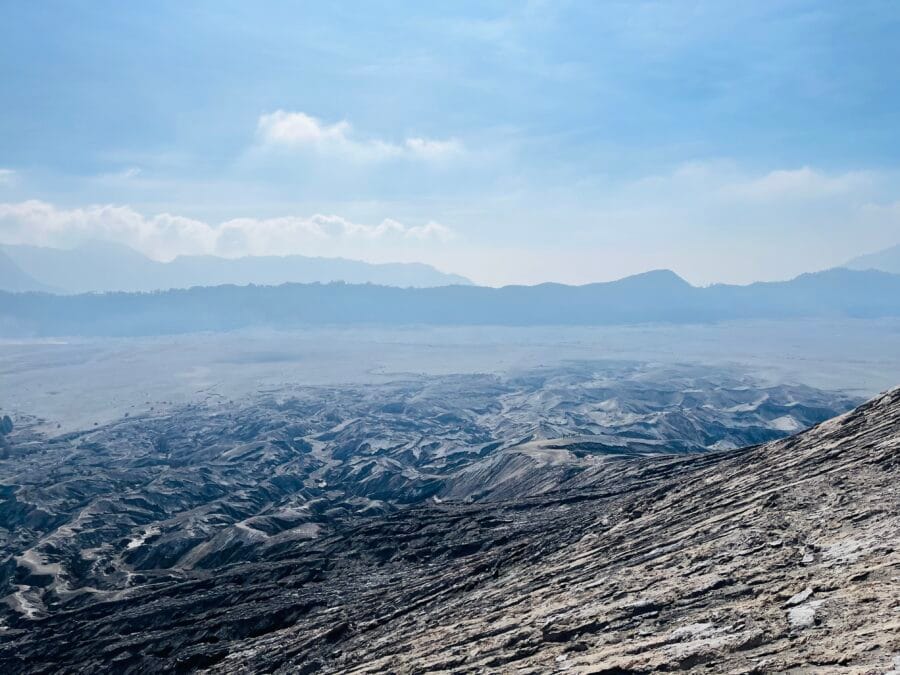
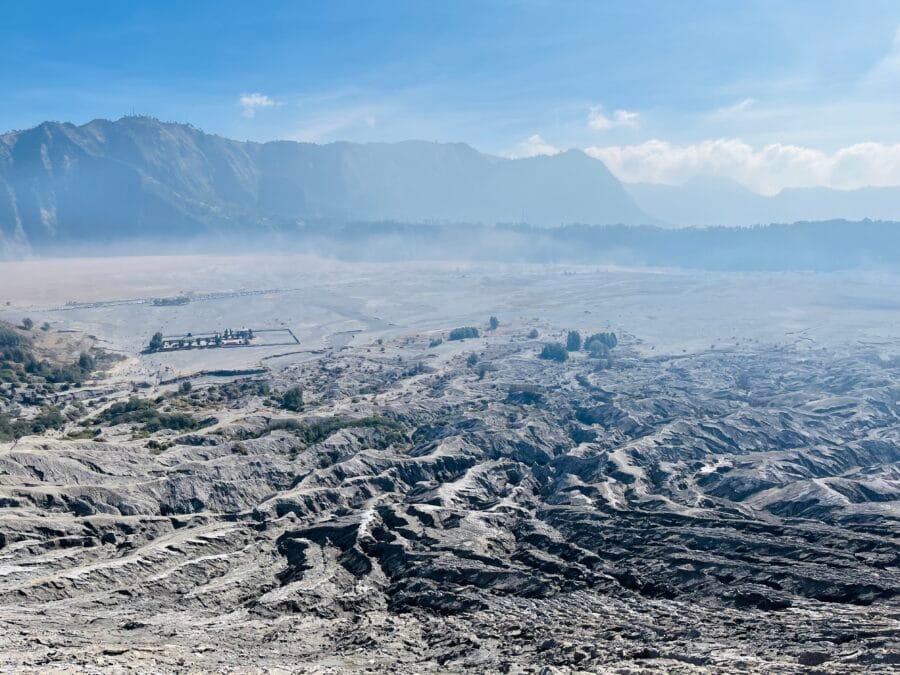
And oh, the view! A steaming crater behind me, rocks yellow with sulfur, fumaroles and clouds of steam, and the occasional hiss coming from the depths. In front of me: the Sea of Sand stretching towards Mount Batok, Semeru in the distance, the vast rim of the caldera – and, far below, the jeeps still racing across the sand.
Marc, meanwhile, had gone a little further along the rim. Fortunately, I didn’t know at the time that he’d gone beyond the point where there was even a teeny fence between him and the crater, and that apparently doing so could result in a rather substantial fine. I was quite happy with my one fence post.
I wasn’t left to admire the view entirely in peace, though. A few Indonesian women approached and asked if they could have their photograph taken with me. This has happened to me more than once in Indonesia. I may be relatively small for Dutch standards, with dark hair and brown eyes, but apparently I still look sufficiently European to be an interesting addition to someone’s holiday photos. At this point I was sweaty, dusty and sitting on the edge of a volcano holding on to a fence post, so I’m not entirely sure what they were getting out of it. But of course I said yes.
And then, of course, we had to go the same way back down. Back through the Sea of Sand, back into the jeep and back to the Lava View Lodge for breakfast, where, after seven hours of exercise on little more than a cup of coffee, my body was screaming, “Sugar! Sugar! Sugar!”
It got fruit.
Lots of it.

Practical considerations
How do I get to Mount Bromo?
Bromo was one of the stops on our Java itinerary, which also included Yogyakarta, Borobudur and Malang. To see Bromo, we took a tour that started from our hotel, the Lava View Lodge, which sits right on the rim of the caldera. This meant a 3 a.m. pick-up and only a few minutes to reach the road leading to the viewpoints.
If you don’t want to stay in the area, you can join one of the many tours from Malang. They will pick you up around midnight, and you’ll spend quite a few hours in a car before transferring to a jeep for the final stretch.
The Bromo Sunrise Viewpoints
There are several viewpoints around Mount Bromo for sunrise, including the famous Penanjakan, Kingkong Hill, Seruni Point and Mentigen Hill. We went to Kingkong Hill, which worked perfectly for us.
Kingkong Hill is lower than Penanjakan and involves a relatively short walk uphill from the jeep drop-off. If you’re not particularly fit, it’s a more manageable option than tackling the higher viewpoints. Do expect a longer uphill walk if you get stuck in the traffic jam and have to get out early, though.
Seruni Point is also lower, but don’t assume that means easier: getting there involves a substantial flight of stairs. Mentigen Hill is the easiest option, as it’s much closer to Cemoro Lawang and can be reached without the climb to the higher viewpoints.
Whichever viewpoint you choose, expect crowds. The road fills with jeeps before sunrise and the viewpoints get busy, but once the sky starts to lighten and the volcanoes appear, you probably won’t care quite so much.

How difficult is the Bromo climb?
How difficult is the walk? If you’re talking about difficult in the sense of “Do I need mountaineering equipment, will I have to scramble over rocks or possibly dangle from cliffs?” — no, it’s not very difficult.
It involves walking uphill on a paved road, walking uphill on a dirt road, walking uphill through volcanic ash and climbing around 250 well-maintained steps with a handrail and viewing platforms along the way.
It is, however, quite strenuous. Expect a cardio workout.

Do you need a horse?
No, you don’t need a horse. I walked all the way up to the crater and back down again without getting on one, and I’m certainly not the fittest person on the planet. It is strenuous, though, and if you do choose a horse, you’ll save yourself the uphill trudge through a layer of volcanic ash.
Not to get on my high horse (pun intended) about animal welfare, but I’d also read reports about the treatment of the horses at Bromo before our trip, and some of them were quite concerning. That, rather than sheer stubbornness, was what stopped me from getting on one. I didn’t see any obvious signs of mistreatment myself, so I’m not going to tell you what decision to make. It’s something you’ll have to decide for yourself.
No matter what you decide, you’ll still have to climb the Stairs of Doom yourself. I didn’t see any horses of the stair-climbing variety.
What to wear for sunrise at Bromo
How cold you find Mount Bromo depends very much on where you’re from and your definition of cold. I’m from northern Europe, I have no trouble keeping warm and I did the whole thing in shorts. I did, however, wear a long-sleeved sports shirt, a fleece and a hat. For me, as long as my upper body is warm, I don’t mind all that much. Also, my only pair of long trousers had been left behind in Sumatra.
If you feel the cold more easily, wear long sleeves, long trousers, warm socks, a hat and a jacket. You will, however, boil on the way up to the Bromo crater, so layers are probably the sensible choice. Whatever you wear, make sure you have decent shoes. This is not the place for flip-flops or other unsuitable footwear. You might also want to bring a scarf or a snood, in case there’s a lot of wind and there’s ash flying all around you.

How long does the Bromo sunrise trip take?
If you leave from one of the hotels on the crater rim, you’ll usually be picked up around 3 a.m. The first part of the journey takes you towards one of the sunrise viewpoints. Depending on the traffic, your jeep may get stuck before you reach the viewpoint, in which case you’ll have to get out and walk the rest of the way. Uphill, of course.
You’ll spend about an hour at the viewpoint, until the sun is fully up, before heading back to the jeeps for the drive into the crater. From there, it’s about 2 kilometres through the Sea of Sand. I think it took us around half an hour to reach the foot of the volcano. The stairs took me what felt like a century, but in reality I think it was about ten minutes. We then spent around half an hour, perhaps a little longer, on the crater rim before heading back down to the jeep and driving back to the hotel.
We left at 3 a.m. and were back at around 10 a.m. Bring snacks. We didn’t eat anything before leaving the hotel, and that’s a long time to be out and about, especially when part of the morning involves climbing a volcano. There are vendors around Bromo, but you can’t necessarily rely on finding something to eat exactly when you need it.

Are there toilets at Mount Bromo?
Yes, there are toilets at Mount Bromo, including down in the crater near the area where all the jeeps park. They are very basic, though. These are squat toilets without a flush. Instead, there is a large cistern of water and what appears to be a ladle. You use the water to clean and flush the toilet yourself. It was an interesting experience.
Practical tip: Use the toilet at your hotel before you leave, and bring your own toilet paper and hand sanitiser. With around seven hours between leaving your hotel room and getting back there, anyone without an iron bladder may well be grateful that those toilets exist.
What If I don’t want to do the Sea of Sand and the Stairs of Doom?
This was a genuine concern of mine before we even flew to Indonesia. Somewhere I read that you could ask your driver to leave you at one of the viewpoints, where you could enjoy the view in peace and quiet while they went back and collected you later. I doubt very much that this person has ever actually been to the Bromo area.
By the time all the traffic is off the road and your driver can make it back up the mountain to collect you, you’ll have had enough peace and quiet to last a lifetime. With a private driver you might be able to arrange it, but I wouldn’t count on it with a group tour.
So what can you do instead? Join the tour down into the crater and, instead of tackling the Stairs of Doom, spend your time marvelling at the caldera around you. It is beautiful and spectacular from down below too. That said, if there is any way you can make it up to the crater rim, don’t miss it. Unless you’ve already had your fill of active volcanoes, in which case I’ll leave that decision entirely up to you.
Is it safe to climb Mount Bromo?
Mount Bromo is an active volcano, so obviously there is a small matter of volcanic activity to consider. Access to the crater can be restricted if conditions are considered unsafe, so always check the current situation before you go.
When the crater is open to visitors, the climb itself is not particularly dangerous. The stairs are well maintained and there is a handrail, although you are climbing through volcanic ash and eventually standing on the edge of an active volcano.
So, yes, you can safely climb Bromo when it’s open to visitors. Just follow the rules, pay attention to any warnings and, perhaps most importantly, don’t fall into the crater. That would rather spoil the trip.

Can you always visit Mount Bromo?
No. Mount Bromo is an active volcano, and access to the crater can be restricted when conditions aren’t considered safe. The sunrise viewpoints may still be accessible even when the crater itself is closed, so you could still get your spectacular Bromo sunrise without actually climbing the stairs.
We were lucky. We visited on August 1, 2026, just before wildfires in the area led to restrictions and eventually a complete closure of the Bromo tourist area.
So if climbing into an active volcano is on your Bromo wish list, check the current conditions before you go. And if the crater is closed, don’t try to sneak in anyway. Apparently, “but I really wanted to see inside the volcano” isn’t a valid safety argument.
Where to stay for Mount Bromo
I could give you a list of hotels and guesthouses near Bromo, but I couldn’t tell you anything that any hotel booking site wouldn’t, with one exception.
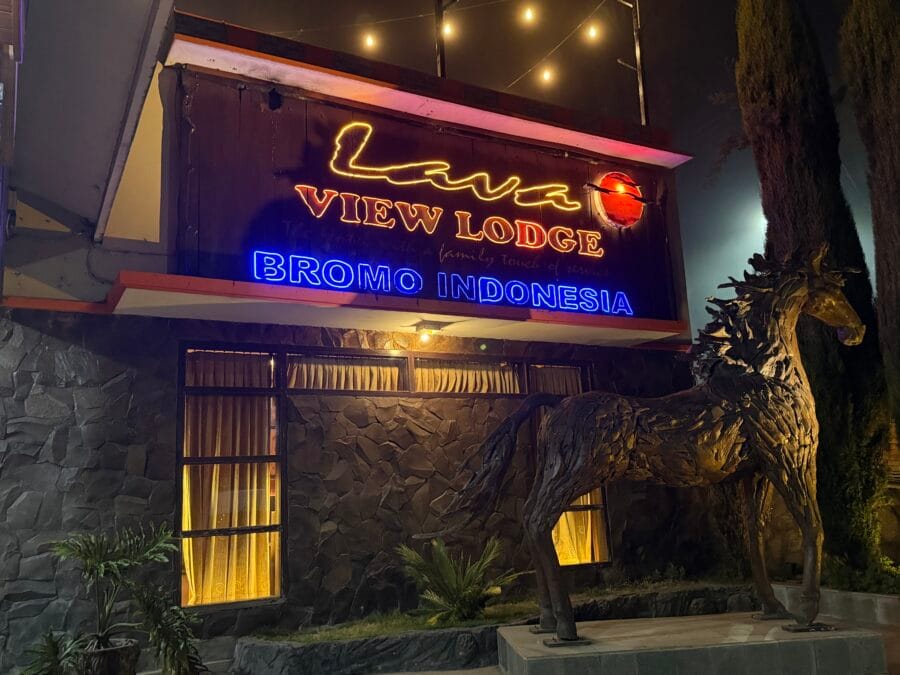
We stayed at Lava View Lodge, which sits right on the crater rim and has an excellent view of the caldera and Bromo itself right outside the door. I’ll write a full review of it later, but suffice it to say that the view alone was worth it, despite the disappointing lack of lava. If you want to know more, read my review of Lava View Lodge.
The rooms and restaurant were perfectly nice and comfortable. It was cold, though, so this might be the time to find some warmer clothes in the depths of your suitcase.
If you’d like to book it for yourself, you can check prices and availability for Lava View Lodge here. This is an affiliate link, which means I may receive a small fee if you book through it, at no extra cost to you.
What tour should I book for Mount Bromo?
I could give you a list of Bromo tours and tell you which one to book, but I can only really tell you about the one we took. Our tour picked us up at the hotel, took us to the sunrise viewpoint and then down into the Sea of Sand and up to the Bromo crater before bringing us back to the hotel.
Now I’m fairly sure there isn’t a tour that takes you to the viewpoint, waits for sunrise and then says, “Right, that’s enough Bromo for today. Back to the hotel.” They’ll all take you into the crater and back out again. So the real choices are whether you want a private or small-group tour, whether you need hotel pick-up, how much you want to spend and, perhaps most importantly, how many people you want squeezed into the jeep with you. We chose a private tour because we liked the idea of doing things at our own pace, and it worked very well for us.
If you’re staying in Malang, you’ll find plenty of tours that pick you up there, usually around midnight. Bear in mind that this means several hours in a car before you even get into the jeep at Bromo. Staying near Bromo, as we did, means you can have a much later start and get straight into the Bromo part of the trip.
I’d check what’s included before booking, particularly where they’ll pick you up and which sunrise viewpoint you’ll visit. Other than that, you’re mostly choosing how much you want to pay for the experience.
You can check the tour we took and current prices here. (Affiliate link).

Can I do Bromo without a tour?
Yes. You don’t actually need a tour or a jeep to visit Mount Bromo. If you’re staying in Cemoro Lawang, you are already right on the edge of the caldera, and you can walk down into the Sea of Sand and make your own way to the volcano.
The tricky bit is getting to the sunrise viewpoint. You’d need to be walking in the dark while everyone else is rattling past you in their Toyota Landcruisers, and you’d still have to get yourself back down again afterwards.
Once you’re in the Sea of Sand, though, there’s nothing particularly complicated about walking to Bromo. You don’t need a jeep to get to the foot of the volcano, although it is a fairly long walk and you’ll be sharing the road with a frankly ridiculous number of jeeps.
So yes, you can absolutely do Bromo independently. Personally, I was quite happy to let someone else deal with the 3 a.m. logistics while I concentrated on not falling off the Stairs of Doom.

More Indonesia travel inspiration
Planning a trip to Indonesia? Here are some of my other Indonesia travel guides and itineraries:
- Indonesia Travel Guide: practical information for planning a trip around Indonesia
- Our Java Itinerary: Yogyakarta, Borobudur, Malang and Bromo
- Our Sumatra Itinerary: Bukit Lawang, Berastagi and Lake Toba
- Madakaripura Waterfall: Rivers, a Motorcycle and the Shoes I Ruined
- How not to lose your phone in a volcano: my slightly unhinged, but still practical preparation for our 26-day Indonesia trip.