How not to lose your phone in a volcano: preparing for Indonesia
There are two types of travellers.
The first type books a flight, throws a few clothes into a backpack, and confidently assumes everything will work itself out. The second type spends several weeks researching local SIM cards, emergency medical facilities, volcano evacuation procedures, and exactly what happens if their brand-new phone disappears into a crater halfway through the trip.
I am, of course, very much the second type.
My husband Marc belongs firmly in the first category. For our upcoming four-week trip to Indonesia, he’ll pack a couple of T-shirts, a pair of shorts, swimming trunks and some toiletries. He will then grab his passport and declare himself ready.
To be fair, this strategy works remarkably well. It also works because he travels with me: someone who has already researched the nearest hospitals, packed enough medication to stock a small pharmacy, created multiple backups of all important documents, and developed a recovery plan for a phone-related volcanic incident. In many ways, I am less a travelling companion and more a slightly anxious support department.
Indonesia isn’t exactly helping, either. This is a country with active volcanoes, chaotic traffic, tropical diseases, possible tsunamis, curious monkeys with a talent for theft, and enough islands to make ending up on the wrong one a genuine possibility. For someone whose brain naturally likes to explore worst-case scenarios, Indonesia is basically an all-you-can-eat buffet of things to worry about. If you’d like to see just how far down that rabbit hole I went, I wrote about it in Overthinking my way to Indonesia.
So naturally, I prepared. Not in a sensible “pack a few extra plasters” kind of way, either.
I built a complete phone-lost-in-a-volcano-or-dropped-into-the-ocean prevention system. I assembled what can only be described as a small travelling field hospital. Then I created enough digital backups to survive a minor technological apocalypse. I also spent an alarming amount of time researching things that will almost certainly never happen.
Will I need any of it? Probably not. Will carrying all these precautions make me feel significantly calmer while travelling through Indonesia? Absolutely.
This is everything I did to prepare for four weeks in Indonesia, from the genuinely useful to the slightly ridiculous. At least, unlike just worrying, it may actually prevent any of the potential disasters that my mind has come up with.
Wondering where we’re actually going? Take a look at our Indonesia itinerary, and why we planned it like that.
The €1300 problem (or: bringing a brand new phone to Indonesia)
I wasn’t originally planning to spend €1300 on a phone. My existing phone worked perfectly well for everyday use. Unfortunately, it also had the habit of turning distant wildlife into small brown pixels. Since Indonesia involves orangutans and dolphins, and since I had already decided not to travel with a DSLR camera, I eventually convinced myself that a new iPhone 17 Pro was a sensible investment. More about how that worked out in my upcoming post “A mediocre photographer’s guide to the iPhone 17 Pro”.
Having just spent a significant amount of money on it, I handled the phone with the care usually associated with undetonated explosives. Indonesia, meanwhile, seemed determined to provide an endless stream of opportunities for it to be dropped, soaked, stolen, buried in volcanic ash or otherwise separated from its owner.
So naturally, I started researching how to stop that from happening. I wanted the phone to survive oceans, volcanoes, tropical downpours, jungle humidity, waterfall spray and the occasional overly curious monkey. More importantly, I wanted it to survive me. Experience suggests that volcanoes are unlikely to eat my phone. I have however successfully misplaced, forgotten or abandoned enough important items over the years that a backup plan seemed prudent. For proof, read about my adventures in travelling to Poland without a passport.
I decided I needed things that would protect the phone if I dropped it, fell on it, accidentally let go of it while leaning over the side of a boat or held it rather too close to monkeys.
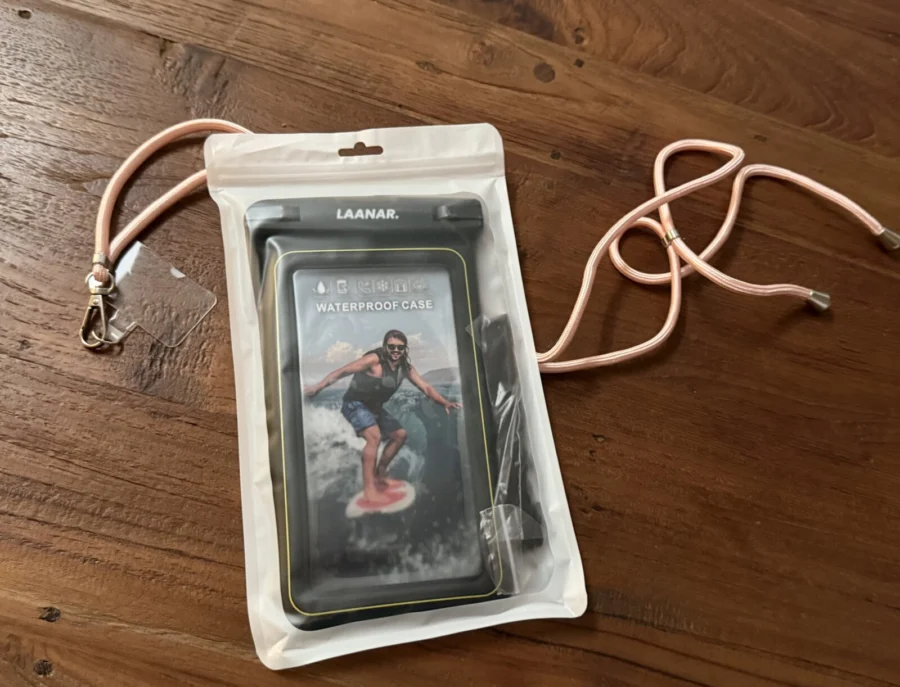
To ensure all of this, I ended up buying a very sturdy phone case. I had a friendly man at the media store apply a NASA-quality screen protector. I added a cross-body phone cord with a nifty little tether solution involving a clear plastic tag that fit neatly into the phone case. Last but not least, I bought a waterproof pouch with built-in flotation. Not air, but foam.
One thing I decided not to buy (but there is still time) is a wrist strap. Because I know I will drop the phone while trying to attach it. Which would sort of go against the whole idea. A final thing I decided against are camera protectors. I felt buying an expensive phone for the cameras and then sticking little layers of glare and distortion over it would be a waste. What I did buy was a little lens cleaning set: blow off the dust, then clean with a microfibre cloth.
Now as always, the main factor when things go wrong and phones do end up in crater lakes is human error. In order for this to work I will need to keep the phone in its case. The phone cord will have to be firmly attached to it on one side and to me on the other. I will have to keep it high on my chest so I don’t accidentally fall on it. It will have to be close to my body so it doesn’t swing out and get smashed against a rock.
Whenever I expect dust, rain or humidity (which will be pretty much all the time) I will have to keep it under my clothes or in a bag and only expose it to the elements when I want to take photos. Which will also be all the time. It will have to go in its pouch whenever I go near boats or the open ocean. Or when I forget that I don’t do well with currents, as proven in my River Kwai Jungle Rafts adventure.
Despite the impressive collection of protective accessories, there remains a small but non-zero chance that my phone will eventually achieve an unscheduled separation from my person. It may sink to the bottom of the ocean, disappear into a volcano, an unusually determined monkey may steal it or I may just leave it on the table in a restaurant.
Since I have learned that “trying not to drop it” is not technically a backup strategy, I also made sure that losing the phone would be deeply inconvenient rather than catastrophic. I’d thought about what would happen if it disappeared and put enough contingency plans in place that replacing it should be mostly a financial problem rather than a trip-ruining one.
Would I be upset? Deeply. But after spending this much money and thought on preparing for the possibility, it would almost feel rude not to be able to say, “Annoying, but entirely according to plan.”
Preparing for a minor technological apocalypse
Losing my phone would be unfortunate. Losing all technology at once would be considerably more inconvenient.
Once I had accepted that phones can disappear into volcanoes, I naturally started wondering what else might decide to stop cooperating. Batteries run flat. Charging cables mysteriously fail. Hotel rooms never seem to have quite enough sockets, and different countries have an irritating tendency to use different plugs. The solution, obviously, was not to trust technology. It was to bring enough backup technology to support the original technology whenever it had a little existential crisis.
That meant a universal travel adapter, a power bank, spare charging cables and a few other bits and pieces to keep everything powered. A phone with an empty battery is only marginally more useful than a phone at the bottom of Lake Toba.
Then there was the question of internet access. I decided to buy an eSIM before leaving, so I should have mobile data from the moment we land. I ended up buying an eSIM through Airalo. It was remarkably easy to set up, which was a welcome change after spending days researching volcanoes. Having mobile data as soon as we get off the plane means I can look up directions, contact hotels, call a Grab, or spend far too much time reassuring my family that I have not, in fact, been kidnapped by orangutans.
Back home, and in much of Europe, I pay for almost everything with my phone. In Indonesia, however, that did not seem like a sensible strategy. Not only because there remains a small possibility that my phone will end up in a volcano, but also because physical bank cards and credit cards are still much more practical in many parts of the world. Mobile payments are far from universal, and if you need cash, you’ll be very glad to have an actual card rather than a phone that may or may not be at the bottom of Lake Toba.
I realise just how much of my life now lives inside one small rectangular object. It is my wallet, camera, map, booking folder, password vault and primary communication device all rolled into one.
Fortunately, there is this wonderful invention called the cloud. My photos are backed up automatically. Booking confirmations, vouchers and other important documents have all been uploaded there as well. I also keep a complete backup of my phone. If it does disappear after all, all I should need is a replacement phone, and my Apple account, which has the one password I actually remember. Everything else lives safely inside my password manager.
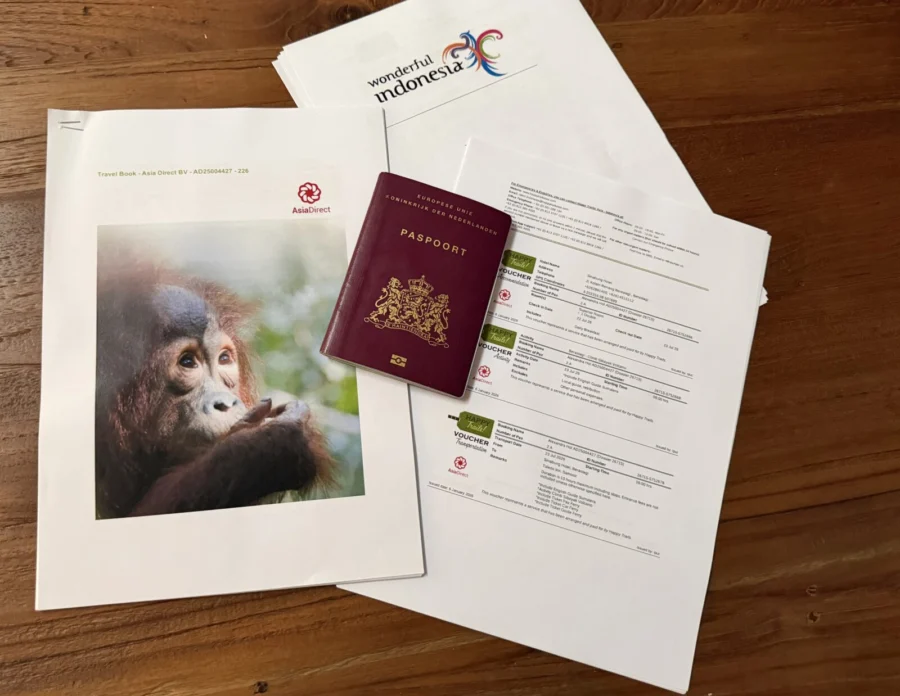
But still, because there are limits to how much faith I am willing to place in modern technology, I printed the important stuff as well. Flight details, hotel reservations, transfer vouchers and travel insurance documents all have a paper version tucked away in my backpack. Paper has several advantages over smartphones. It never runs out of battery, loses reception or decides that now would be an excellent moment to install a software update.
Luckily, I won’t have to rely on paper alone. My primary contingency plan is called Marc. Or, more specifically, Marc’s phone.
The field hospital (or: items I hope not to use)
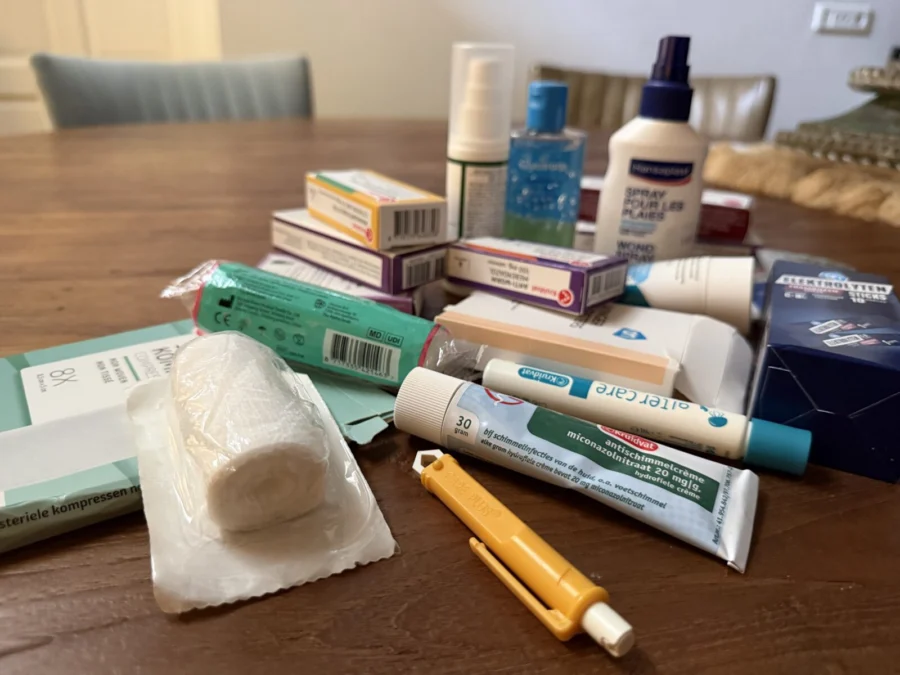
After spending a significant amount of time convincing myself that my phone might not survive Indonesia, it occurred to me that I probably ought to think about the person carrying it as well. Unfortunately, Google has very strong opinions about what can happen to travellers in tropical countries. After a few evenings of research, I was no longer packing for a holiday. I appeared to be preparing to open a small outpatient clinic somewhere on Sumatra.
According to the internet, I was about to encounter food poisoning, mosquito-borne diseases, infected mosquito bites, dehydration, blisters, cuts, heat exhaustion, bloodloss-by-leech and a remarkable number of digestive adventures. Every website reassured me that these things were relatively uncommon. They also all had a helpful list of things I absolutely shouldn’t travel without.
Part of my research wasn’t just about tropical diseases. I also wondered whether I was actually fit enough for this trip, something I wrote about in Will I Fit? Will I Cope?
Somewhere along the way, I stopped asking myself, “Will I need this?”. Instead, I started wondering, “What if this is the one thing I don’t bring and then need?” Before I knew it, my travel pharmacy had grown into a reassuringly comprehensive collection of medication for the ailments I was most likely to encounter, together with a first-aid kit for the injuries I fully intend not to sustain.
Then there were the items that found their way onto my packing list simply because Google can be remarkably persuasive. Every article introduced another problem I hadn’t considered. Dehydration? Electrolyte sachets. Mosquitoes? Stronger repellent. Tropical humidity? Anti-chafe-shorts. Slippery jungle roots? Trekking poles. By the time I’d finished researching, I was no longer asking, “Do I really need this?” I was asking, “What horrifying thing does this prevent?”
Whether any of those items will ever leave their packaging remains to be seen. But if they return home untouched, I’ll consider that an excellent result.
If you’re curious about what actually made it into my medical kit, I’ll share the full list in my upcoming Indonesia packing guide. This post is more about how I managed to convince myself that I needed one in the first place.
Visas, insurance and other adult responsibilities
There comes a point in preparing for a trip when you have to stop imagining tsunamis, tropical diseases and rogue monkeys, and start behaving like a responsible adult.
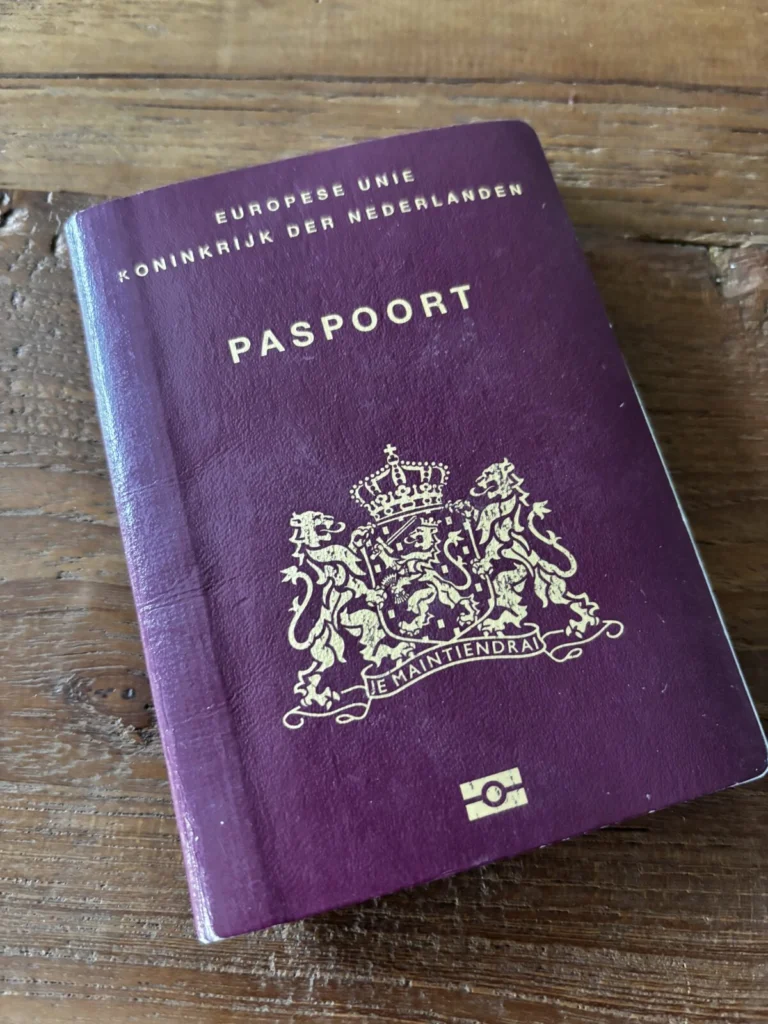
For Indonesia, that meant rather more paperwork than I’d anticipated. There was the eVisa, the All Indonesia arrival card, the Bali tourist levy, passport checks (6 months validity required), travel insurance, hotel reservations and enough booking confirmations to convince several different organisations that I really was planning to visit the country, not move to it permanently. None of it was particularly difficult. Fortunately, most of it could be arranged online before we left, leaving us with one less thing to worry about on arrival. The only thing that I needed to keep track of: what to do when?
I also remembered to set my bank cards to “world” rather than “Europe”. Paying for lunch is much easier when your bank agrees that Indonesia exists. Having once managed to travel to Poland without my passport, I wasn’t taking any chances this time. I checked our passports, made digital copies of every important document, uploaded them to the cloud and, because old habits die hard, printed the most important ones as well.
Annoyingly, I discovered two days before departure that I wouldn’t be allowed to bring my prescription medication into Indonesia without a full prescription and a doctor’s letter on official practice paper, signed and stamped. This was one discovery I would rather have made slightly earlier, but I managed to sort it out. Something worth checking for anyone travelling with prescription medication.
Travel insurance received rather more attention than it probably deserved. I spent a surprising amount of time reading the policy documents. This was mainly to reassure myself that if one of my increasingly elaborate disaster scenarios actually came true, someone else would eventually deal with the expensive bits. I fully expect the emergency phone number to remain nothing more than a reassuring presence in my backpack.
Like so much of my preparation, none of this is particularly glamorous. Nobody gets excited about visas, insurance documents or checking passport expiry dates. But if everything goes wrong, these are probably the preparations I’ll be most grateful for.
Official Indonesia travel resources
If you’re planning your own trip, I’ve linked the official websites below so you don’t accidentally end up on one of the many unofficial visa sites that Google also seems rather fond of.
These are the official websites you’ll need before travelling to Indonesia. Depending on your itinerary, you may not need every one of them. For example, the Love Bali Tourist Levy only applies if you’re visiting Bali.
Indonesia eVisa
All Indonesia Arrival Card
Love Bali Tourist Levy (Bali arrivals only)
Note: The All Indonesia Arrival Card is Indonesia’s new integrated arrival portal. Depending on where you enter the country, it may include your customs declaration, health declaration and other arrival formalities in a single submission.
Somewhere between bra storage and a utility vest: where do I put all this stuff?
Now, between my trekking poles, mobile field hospital, phone survival system and ever-growing collection of paperwork, a new problem arose. Where was I supposed to put all this stuff? At home, my storage strategy is wonderfully simple. My phone lives in my bra, my keys in a pocket and everything else stays exactly where it belongs: at home. Somehow I didn’t think that would be quite sufficient for four weeks in Indonesia. If only because I had absolutely no idea where I would put my passport.
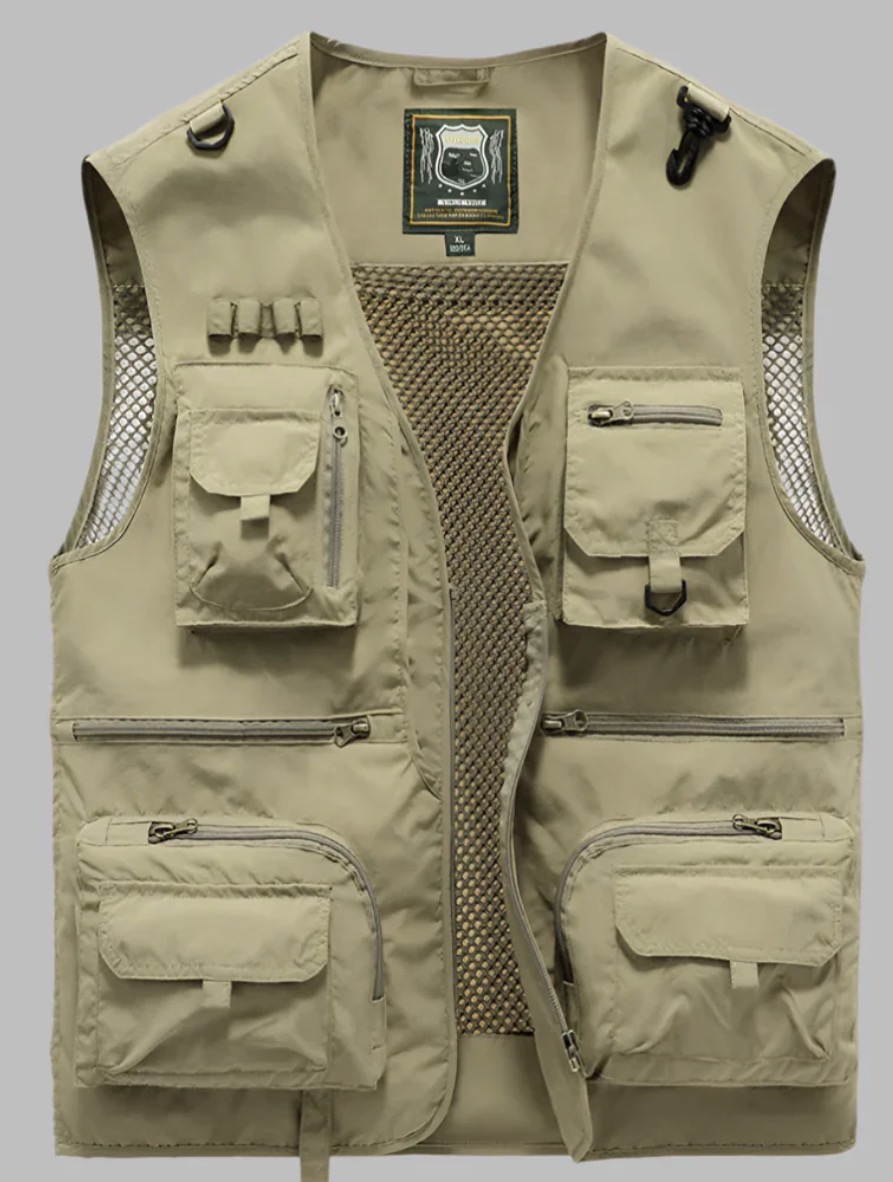
I briefly considered an Indiana Jones-style utility vest, complete with enough pockets for all my gadgets, carabiners to attach things to and perhaps a sturdy hook on the back in case I fell into a river and needed to be hauled out. I even suggested this to Marc.
Turns out there is only so much a marriage can survive.
The solution was much simpler. I have a bright blue backpack. It’s large enough to hold everything I could possibly need and has approximately fifteen different compartments to organise it all. Since Marc vetoed the utility vest, he has automatically volunteered to carry the backpack. He will also stand patiently while I search all fifteen compartments for whichever item I urgently require at that particular moment: my passport, my rain poncho, my lens cleaning kit, the hotel key or, quite possibly, our emergency snacks.
It’s only fair.
Is any of this necessary?
Over the past few weeks, I have found myself researching volcano evacuation procedures, monkeys, scams and other forms of organised theft, local SIM cards and internet survival, and how to get away from a tsunami. Whether any of this will prove useful is hard to tell at this point. But if I had to make a guess: probably not.
The floating phone pouch will most likely spend four weeks proving that I had dramatically overestimated the likelihood of losing my phone. The emergency medication will remain untouched. I will never need the backups. The tsunami will quietly stay on the list alongside the volcanoes, tropical diseases and phone theft. But that’s not really the point.
One advantage of researching every conceivable disaster before a trip is that, once a catastrophe has been added to the list, it becomes slightly less worrying. I realise this is not how risk assessment works. Nevertheless, after remembering that Indonesia is located in a seismically active region and briefly considering the possibility of tsunamis, I felt noticeably calmer.
The tsunami had been acknowledged. It could now join volcanoes, tropical diseases and phone theft on the official list of things I had worried about and therefore almost certainly prevented.
Magical thinking? Absolutely. But if anxiety could be defeated by logic, I would have packed much lighter.
To be fair, some preparation really does help. Having travel insurance, backups of important documents, a basic medical kit and a plan for the unexpected can make the difference between a minor inconvenience and a major disaster. Most travellers should probably do at least some of these things. Whether anyone needs a complete phone-loss-in-a-volcano recovery strategy is perhaps more debatable.
Still, if I make it through four weeks in Indonesia without requiring assistance from the Dutch consulate, an emergency airlift or a search party, I shall consider the preparation a success. Marc will attribute this outcome to common sense and good fortune. I will attribute it to the seventeen backup plans, multiple copies of every important document, and the fact that I remembered to add tsunamis to the list.
This article is part of my Overthinker’s Guide to Indonesia, where I share experiences, tips, reviews and the inevitable mishaps.
If you’d like to read more, you’re very welcome to subscribe to my mailing list.